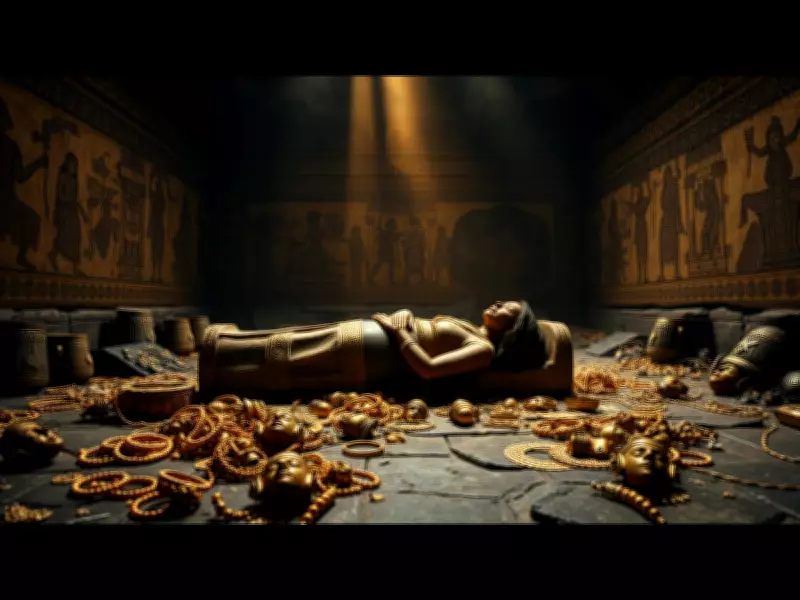
In 2013, archaeologists revealed an unlooted Wari tomb after clearing tons of stone to reach a burial complex. What they found underneath challenged previous views about social organization in the ancient Andes. They uncovered an intact, unlooted Wari royal tomb—a find that has reshaped understanding of Wari imperial power. Inside this intact tomb were remains of elite women buried with gold and silver jewellery. Because the site had not been disturbed by grave robbers, it provided a rare, intact glimpse of wealth, power and ritual in ancient Peru.
A Tomb Protected by Desert
Castillo de Huarmey is located in a harsh, dry, coastal desert. These ultra-dry conditions acted as a natural barrier that sealed the burial complex and preserved fragile materials for centuries. Archaeologists had to move a lot of stone in order to reach the tomb chamber. The structure was difficult to access and remained protected for centuries. The tomb remained intact—not collapsed or looted—preserving its original context. In archaeology, context often matters more than gold: placement and associations tell us how people acted and remembered the dead. It shows exactly how the dead were placed, venerated and remembered by their society.
Castillo de Huarmey is listed as one of the main northern coastal centres of the empire in a peer-reviewed study on Wari expansion published in PLOS ONE. The study suggests the site was part of a wider Wari political and ritual network.

Gold, Silver and Superb Preservation
The precious metals in the mausoleum were a direct statement of high social rank. The gold and silver objects were not the casual offerings of a grieving family. Such wealth in a royal imperial tomb suggests access to skilled labour, trade routes and state authority. The tomb was closed to the public, but the splendour of the burial may have helped express the legitimacy and status of the ruling elite.
The desert environment meant that organic materials survived alongside the metallic treasures. The dry conditions preserved fragile elements such as hair, textiles, leather, food remains and even original paint pigments. In wetter climates, these materials rot away, never to be seen again. At Castillo de Huarmey, this well-preserved organic record offered scholars evidence that the entire space was intentionally managed. The arrangement and objects displayed were part of a well-planned ceremony to transmit the status of the deceased into the afterlife.
Recovering Women's Roles
The most significant feature of the discovery was that elite women were at the very heart of the mausoleum. This was not a male king buried with female attendants. Rather, women of high rank occupied central positions in the mausoleum. A study published in PNAS on Andean elite burials claims to have changed the way scholars talk about gender and authority in ancient Peru. The evidence shows that women may have held important political and ritual roles in dynastic memory. For a long time, older historical theories assumed that political power in the ancient Andes was almost entirely a male preserve. Castillo de Huarmey suggests women could exercise power at state levels in the Wari empire.
This discovery has been built upon in later scientific research. Experts have examined the bone and tooth enamel of the buried women to learn about their early lives and diets. This work helps researchers determine whether these queens were local to the coast, highland immigrants, or part of wider imperial networks. By examining the physical remains, not just the gold, scientists can reconstruct the real biographies of these powerful women, replacing speculation with stronger biological and archaeological evidence.