Air India Express Boeing 737 MAX Experiences Hard Landing in Phuket, Nose Wheels Detach
An Air India Express Boeing 737 MAX aircraft, carrying a total of 138 individuals, executed a hard landing at Phuket International Airport on Wednesday. The incident resulted in the detachment of both nose wheels, although fortunately, no injuries were reported among the passengers or crew members.
Details of the Incident and Immediate Response
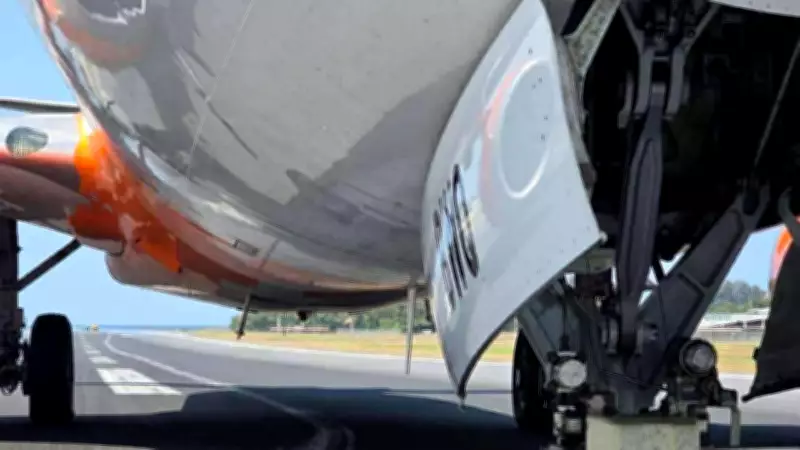
The flight, identified as IX 938, had departed from Hyderabad and was en route to Phuket. Upon landing at approximately 11:25 AM local time, the aircraft experienced a hard touchdown, followed by a bounce. During the second contact with the runway, both nose wheels became detached, causing the plane to become stuck on the airstrip.
Passengers were safely deplaned on the runway and escorted to the terminal building. Subsequently, the aircraft was towed to a bay for further inspection. In response to the incident, Phuket Airport temporarily closed its sole runway to conduct necessary safety checks, disrupting flight operations until the strip could be deemed operational again.

Investigation and Official Statements
The Directorate General of Civil Aviation (DGCA) has confirmed that it is in close coordination with Thai aviation authorities to investigate the suspected hard landing. A senior DGCA official provided a statement, noting that the aircraft, registered as VT-BWQ, had undergone routine maintenance with both nose wheels replaced on March 8, 2026.
"Investigation will be carried out by the appropriate authority after consultation with Thailand Aviation Investigation Authorities, Thailand being the State of occurrence," the official stated, emphasizing the procedural steps ahead.
An Air India Express spokesperson acknowledged the issue, confirming that the flight experienced a problem with the nose wheel at Phuket Airport. "The crew followed all standard protocols, and guests were deplaned. We thank our guests, the Phuket airport authorities, and all stakeholders for their cooperation," the spokesperson added.
Expert Analysis and Contributing Factors
Aviation experts have weighed in on the incident, with a senior Boeing 737 captain describing it as a clear case of a hard landing leading to nose wheel damage. The captain suggested that the optimal response might have been to execute a go-around after the initial bounce, though he emphasized that only a thorough probe can determine the exact sequence of events.
Additionally, experienced pilots highlighted the challenging landing conditions at Phuket Airport. The runway features a pronounced upslope followed by a downslope, which can compromise "flare perception"—the critical visual and sensory process pilots use to judge altitude, speed, and closure rate for a smooth touchdown.
This perceptual challenge involves shifting focus from the end of the runway to the sides to utilize peripheral vision for sensing height and "ground rush." A pilot familiar with the airport noted, "Phuket is a tricky place to land if the winds are strong and thermals during hot afternoon time, which is usually the case there."
Ongoing Actions and Future Steps
The aircraft remains grounded in Phuket, and Air India Express has announced plans to dispatch its engineers to conduct repairs. The investigation will delve into multiple potential factors, including pilot actions, aircraft maintenance history, and environmental conditions at the time of landing.
This incident underscores the importance of rigorous safety protocols and continuous training for flight crews, especially when operating in airports with complex geographical features. As the probe progresses, further updates are expected from both Indian and Thai aviation authorities.