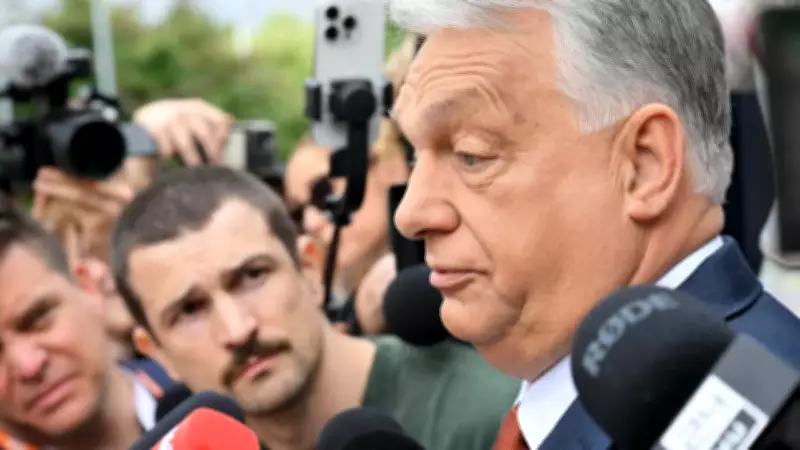
European Union leaders are convening for a summit in Brussels on Thursday, marking the first time in 16 years that Hungarian politician Viktor Orban is not present. Over the years, prime ministers, chancellors, and presidents have come and gone, but Orban remained a constant figure in Brussels' corridors of power, steering Europe toward the right and pioneering a nationalist populism that has gained traction across the continent and inspired the Make America Great Again movement in the United States.
Orban's New Role on the Sidelines
Orban, now Hungary's leading opposition figure after losing a pivotal election in April, frequently clashed with the EU, vilifying its institutions and leaders while dismantling checks and balances in Hungary. Long a thorn in the EU's side regarding Ukraine and other issues, he now watches from the sidelines as his successor, Peter Magyar, joins leaders like Spain's Pedro Sanchez, France's Emmanuel Macron, and Germany's Friedrich Merz to advance policies that likely conflict with Orban's vision.
As the EU summit opened to discuss bolstering support for Ukraine, Orban was surrounded by his far-right allies from his new position outside the halls of power he once dominated. He is in Brussels to attend a summit of his Patriots for Europe party group, a coalition of far-right parties across the bloc that forms the third-largest caucus in the European Parliament.

Sidelined but Among Family
Despite his election loss—welcomed with relief by many EU leaders and seen as a rebuke of his combative stance toward the EU and close ties to Russia—Orban remains convinced that far-right parties in Europe are on the verge of a breakthrough. At a news conference in Brussels on Wednesday, he stated that his defeat had not halted "the rise of patriotic political organizations, communities, and parties across Europe." He added, "No one election loss can stop this historical process. Anti-migration and sovereigntist political forces in Europe will continue to grow stronger in the coming months and years."
Orban hopes the Patriots for Europe will transform the EU according to his vision, reducing the bloc's role in rule of law and democracy, adopting a zero-tolerance immigration policy, and fostering deeper cooperation with Russia and China. He had been the primary obstacle to EU efforts to integrate Ukraine, but Hungary's new government under Magyar and his center-right Tisza party has pledged more constructive cooperation with the EU. Last week, Hungary lifted its veto on starting Ukraine's accession process after negotiations with Kyiv on restoring minority rights for ethnic Hungarians in western Ukraine.
Thomas Byrne, Ireland's Minister for European Affairs, noted that Hungary resolved its issues to allow this progress. Ireland will take the rotating EU presidency in July, during which accession talks for Ukraine and Moldova are expected to accelerate.
An Ambitious Far Right
Europe's far right has achieved recent successes. France's National Rally, led by Marine Le Pen, gained ground in municipal elections, while the Alternative for Germany (AfD) is rising in polls. Czech populist leader Andrej Babis, an Orban ally, returned as prime minister last year and is the only Patriots member leading an EU nation.
The far right also influenced EU migration policy through an alliance with the center-right European People's Party, leading to measures that human rights groups criticize for increasing surveillance, deportations, and setting up detention centers outside the EU called "return hubs." When the right-wing coalition passed the migration reform on Wednesday, far-right and center-right lawmakers cheered in the European Parliament chamber in Strasbourg, chanting "Send them back."
However, fractures have emerged within Europe's far right over discomfort with U.S. and Israeli policies in Iran and President Donald Trump's threats to annex Greenland, a territory of EU member Denmark. With Orban no longer able to veto EU decisions—a tactic that defined his role at summits—Ukraine's main obstacle to beginning EU accession talks has been removed.