Nagpur: Once ravaged by left-wing extremism, Gadchiroli district is undergoing a metamorphosis as the next big tourism destination, revealing itself as Vidarbha's hidden gem in the south-eastern corner of Maharashtra. The forbidden zones of yesterday—the deep forests, silent hills, and tribal heartlands long marked off-limits—are now ready to welcome tourists. This is a landscape of beauty and terrain where the mighty dinosaurs once walked, a memory preserved in the fossils unearthed near the Godavari Basin.
A Diverse Tourism Canvas
The district collector's office documents Gadchiroli's tourism canvas as one that is unexpectedly varied. It moves from spectacular forested landscapes and dramatic river confluences to riverside temples and tribal pilgrimages, a tourism spectrum few corners of Maharashtra can match. There are waterfalls, a fossil park bearing dinosaur remains, a Mahabharat-era shelter on a forested hilltop, and sanctuaries with tigers and leopards.
Cultural Richness of the Gond Tribes
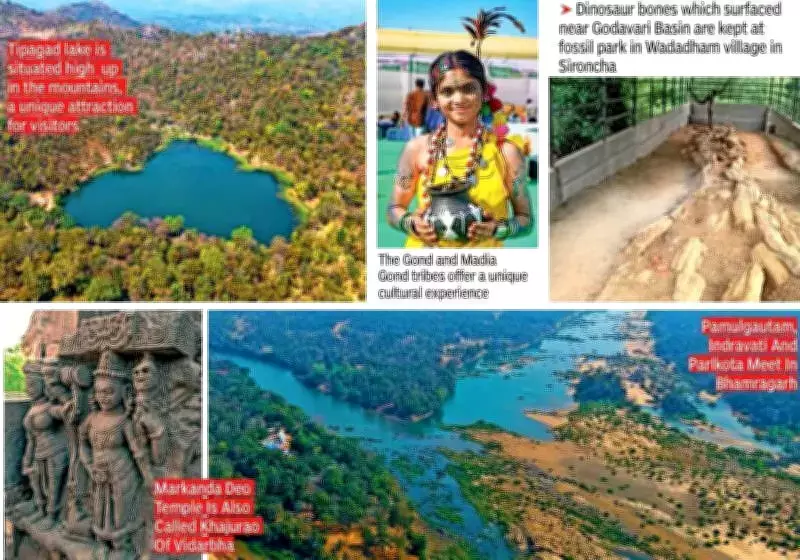
Gadchiroli vlogger Shubham Parvekar, who documents the district's unexplored corners, said what gives the district its distinct character is its people. "The Gond community is one of the largest tribal groups in India. The daily routine, ancient traditions, and lifestyle of the Gond and Madia Gond tribes offer a unique cultural experience that you won't see anywhere else." Parvekar also pointed to the district's temples. "The Markandeshwar temple in Chamorshi taluka is known as the Khajuraho of Vidarbha. The incredible artwork and sculptures carved on this temple, located right on the riverbank, are rare sights you will hardly find anywhere else in Vidarbha."

Prehistoric Wonders: Dinosaur Fossils
Time runs deeper here than the maps suggest. Sironcha taluka, in the district's southern reaches, is one of only five places in the country where dinosaur fossils have been found in large numbers. The bones surfaced near the Godavari Basin, where great reptilian creatures once walked, and are now showcased at a fossil park in Wadadham village. The park, managed by the forest department, is open to those willing to make the long drive south. The first complete dinosaur skeleton out of Sironcha was unearthed in 1959, identified as Barapasaurus tagorei and now displayed at the Indian Statistical Institute in Kolkata. In 2018, a team of palaeontologists from different countries pulled more than 70 Jurassic-age bones, dated between 150 million and 160 million years old, from the same area. Among the finds were claws, a series of vertebrae, and the limb bones of what looked like a new sauropod species.
Mythological and Sacred Sites
Move north into Aheri taluka and the timeline shifts again. Four kilometres into the dense forest from Repanpalli village, on a wooded hilltop, is a place that local lore identifies as the Lakshagruh of the Mahabharat, where the Pandavas stayed and which was set ablaze by the Kauravas. While the more popular view is that Lakshagruh lies in present-day Uttar Pradesh, local belief holds that Lakka Meta is the place from where Pandavas escaped through a hidden passage that opened into a lake. The district collector's web portal states that the shelter was made up of natural elements that kept burning slowly, allowing the Pandavas ample time to escape.
Sacred sites carry the same weight of time. On a bend of the Vainganga in Chamorshi, the Markanda Deo temple stands as a complex of carved stone, drawing devotees for the granular detail of its sculptural work and the quiet pull of the riverbank. South at Chaprala, the dham founded in 1935 by Kartik Swami Maharaj sits where the Wardha and Vainganga unite to form the Pranhita, the river that divides Maharashtra from Telangana. Every 12 years, at Sironcha in the district's deep south, the Pushkar Kumbh draws lakhs from three states for ritual bathing at the Pranhita ghat and darshan at Kaleshwaram temple.

River Confluences and Waterfalls
At Bhamragad, the Pamulgautam, Indravati, and Parlkota meet in a tri-river spread, popularly known as sangam. Further south at Somnur, the Godavari and Indravati come together in a roar that locals say travels far, the waters flanked by high mountains where three rivers and three states converge. In Abujmarh, the Indras Fall takes six hills as its steps to reach the Bada Madia hamlet at Binagunda, a cluster the world reaches only by patience.
Infrastructure and Accessibility
For now, the road remains the only reliable way into Gadchiroli. Luxury private accommodations have not yet arrived in the district, but budget hotels, lodges, and PWD guest houses cover the visitor's needs. Guided tours are still in a nascent stage. Gadchiroli is for those who are willing to accept surprises along the way rather than a pre-set tour itinerary.
The state government, on a war footing, has started projects to connect Gadchiroli by air and broad-gauge railway, apart from constructing a highway to connect the district with the Samruddhi Expressway. With Maoism ended, the mining sector opening up, and investment flowing in, the infrastructure that follows is expected to carry the tourism story forward.