

Long before the mighty dinosaurs walked the Earth, our planet was dominated by a different kind of giant. While today we marvel at large arthropods like coconut crabs or giant millipedes, none compare to the truly enormous creatures that once roamed the prehistoric world.
The Colossal Arthropleura: Earth's Largest Land Invertebrate
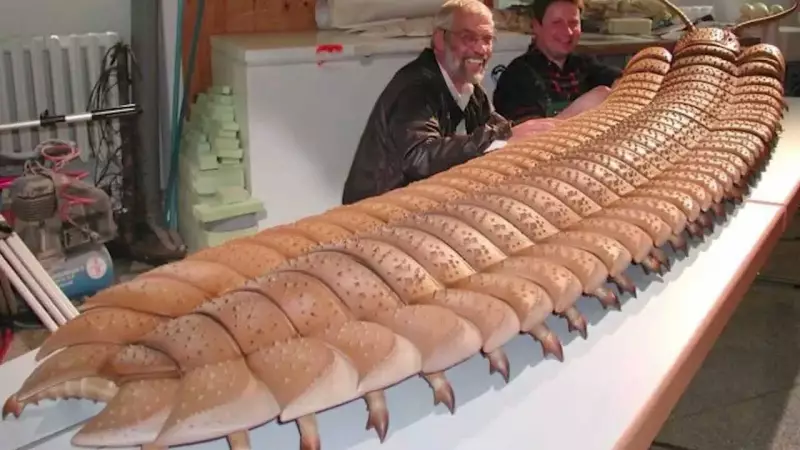
In Earth's natural calendar, approximately 300 million years ago during the late Carboniferous era, a creature named Arthropleura reigned as the largest known terrestrial invertebrate. This prehistoric giant would have stood at an utterly intimidating level compared to any human, reaching lengths of more than 2.5 meters with some estimates suggesting it could grow to 3 meters long.
Despite its potentially frightening stature, Arthropleura was not a fearsome predator. In fact, this gentle giant preferred to feed on decaying plant matter, making it a herbivore or detritivore rather than a carnivorous threat.

Arthropleura's Environment and Physical Structure
Arthropleura lived approximately 346 to 290 million years ago, during a period when Earth's continents clustered near the equator. This geographical arrangement created extensive tropical forests that covered much of the land surface.
The late Carboniferous era was characterized by:
- Dense, lush vegetation
- Towering ferns, lycopsids, and horsetails
- Abundant food sources for herbivorous invertebrates
- Extensive shelter opportunities
Fossil evidence reveals that Arthropleura possessed dozens of body segments with paired legs along each segment, giving it a flattened, armored appearance. This body structure, combined with overlapping plates, would have provided both flexibility and protection as it navigated the forest floor.
While scientists initially debated whether it was a millipede, centipede, or unique creature, they now classify Arthropleura within Myriapoda, the group that includes modern millipedes and centipedes. Its closest living relatives are millipedes, with which it shares structural and feeding similarities.
Scientific Discoveries About Arthropleura's Size
One major challenge in understanding Arthropleura's true dimensions has been the scarcity of complete fossils. Researchers have primarily relied on fragmented exoskeletons and trackways preserved in stone to reconstruct this prehistoric giant.
Recent studies have significantly advanced our understanding of Arthropleura's colossal proportions. A 2025 study from France yielded the most complete excavations to date, focusing on well-preserved sections and trackways measuring up to 50 centimeters in width.
The largest known species of Arthropleura could attain lengths of 2.5 to 3 meters, making it larger than most humans and comparable in size to a modern alligator. These findings confirm its position as not only the largest arthropod ever to walk on land but also the largest in Earth's entire history, far outgrowing any of its modern relatives.
Despite its enormous size, Arthropleura's anatomy clearly indicates it was not a predator. Analysis of its mouthparts and gastrointestinal contents reveals it was a slow-moving herbivore or detritivore. Its massive size likely helped it capitalize on abundant food supplies without facing significant competition from other creatures.
Why Arthropleura Grew to Gigantic Proportions
The enormous size of Arthropleura was no accident. A combination of environmental and physiological factors facilitated its remarkable growth:

- High Atmospheric Oxygen: During the Late Carboniferous Period, atmospheric oxygen levels rose to 30-35%, compared to today's 21%. Arthropods breathe through a tracheal system where oxygen diffuses directly to tissues. This higher oxygen concentration removed size constraints that limit modern arthropods.
- Abundant Food Supply: The Carboniferous forests produced massive quantities of leaf litter and vegetation, creating an exceptionally rich food source that supported the growth of gigantic species.
- Low Predation Pressure: During this period, land vertebrates were relatively small and less numerous as predators. This allowed large arthropod species to grow without significant predation threats, making size an advantage rather than a liability.
These combined factors created an environment where arthropods could reach sizes that are almost unimaginable by today's standards.
The Decline and Extinction of Arthropleura
The late Carboniferous gradually transitioned into the early Permian period, bringing significant environmental changes that would prove challenging for giant arthropods like Arthropleura.
Key changes included:
- Forests becoming drier and more fragmented
- Declining atmospheric oxygen levels
- Emergence of more efficient vertebrate predators
These environmental shifts placed immense evolutionary pressure on large arthropods. Reduced oxygen made sustaining a giant body more difficult, habitat fragmentation limited available resources, and increased predation created new survival challenges.
Consequently, Arthropleura disappeared from the fossil record around 290 million years ago, marking the end of an era when arthropods dominated terrestrial ecosystems at truly colossal sizes. This extinction paved the way for different life forms, including the eventual rise of the dinosaurs that would come to dominate Earth millions of years later.





