

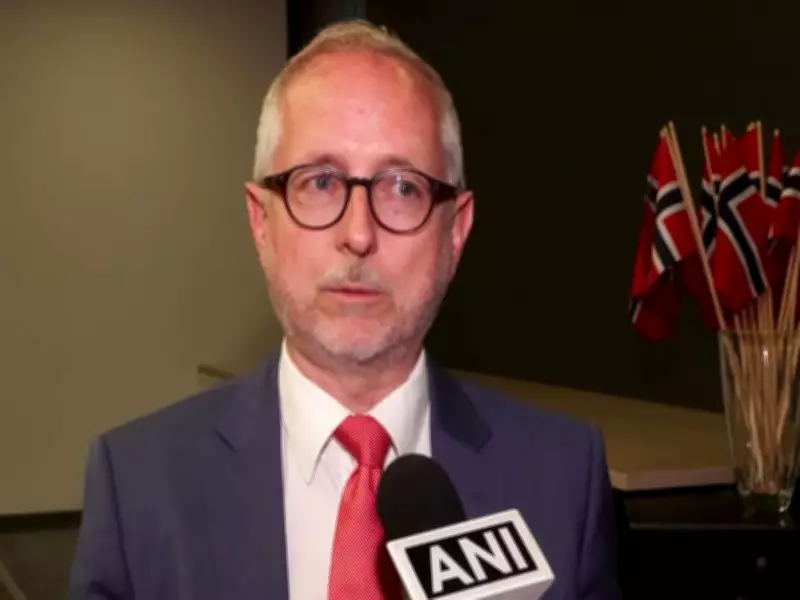
Bard Vegar Solhjell, CEO of Renewables Norway (Fornybar Norge), has described India as a central pillar of the global shift toward clean energy, calling for strategic green partnerships between the two countries. In an interview with ANI, the former Norwegian Minister of Education and Minister of Environment emphasized that India should be viewed not merely as a developing market but as a critical strategic partner and a global powerhouse in clean technology manufacturing.
India's role in global climate action
"India is hugely important in the energy transition. That's why we are here," Solhjell stated. He added that if India achieves its ambitious climate goals, it could be the most important development for the global climate. India's strong economic growth—the strongest among all large countries—combined with its aggressive renewable energy targets makes it indispensable for the world's decarbonization efforts.
Solhjell identified three primary sectors where Norwegian expertise aligns with India's evolving grid infrastructure: hydropower, offshore wind, and carbon capture and storage (CCS). Norway has a century-long history with hydropower, which provides roughly 90% of its electricity, making it one of Europe's largest hydro producers. India's rapid expansion of variable solar and wind power creates a pressing need for storage capacity, a domain where Norwegian experience with pump storage can offer common ground.

Offshore wind and carbon capture opportunities
While offshore wind is still in its infancy for both nations, Solhjell described it as a vital future alternative. "Now solar and onshore wind are cheaper, but in the future offshore wind could be a very important alternative if we can get the technology right and get costs down," he said. He noted that collaboration between India and Norway could help advance technology and lower capital costs for offshore wind projects.
On carbon capture and storage, Solhjell pointed to Norway's two flagship commercial-scale facilities—one in cement and one in waste management. Insights from his visit to India highlighted how relevant CCS technology will be for decoupling India's heavy industrial growth from carbon emissions. "I think I've learned here how important this might also be for India. So that's a third option," he said.
Strategic importance and market opportunities
Solhjell stressed that India is strategically important for European countries because it is a leader in the global energy transition and a manufacturer of products such as batteries and solar components. "First of all, of course, it's a big market opportunity. Several Norwegian companies are already here," he noted. He added that Prime Minister Narendra Modi's official visit to Norway from May 18-19 acted as a massive catalyst, igniting a wave of corporate curiosity across the Nordic region. "Prime Minister Modi's visit to Norway is a big news story, not only in Norway but throughout the Nordics. I think it really boosted interest in India," Solhjell observed. The visit pushed many Norwegian firms from "vague interest" to actively researching entry strategies into the Indian market.
Peer-to-peer partnership model
Rejecting the outdated narrative that Western nations must simply hand down technology to developing economies, Solhjell advocated for a peer-to-peer partnership model based on mutual strengths. "I don't think India is any less developed now in terms of technology than many European countries, rather the opposite, to be honest. So maybe we should think more about partnerships where we are strong in some areas, you are very strong in other areas, and where capital and competence go both ways," he said.

With India emerging as a major manufacturing hub for critical components like batteries and solar modules, European countries are looking to India to diversify supply chains. Solhjell also noted that ongoing geopolitical fractures—such as the conflict in Ukraine and instability in West Asia—have accelerated the drive for energy independence, turning renewable energy from a purely environmental goal into a vital element of national security. "Most of all, it has become more urgent because energy independence and energy security have become much more important. Right now, I think the drive and the urgency are the stronger forces. We see that in renewable growth, both in Europe and India, and it will lead to a faster transition because we need it," he concluded.





