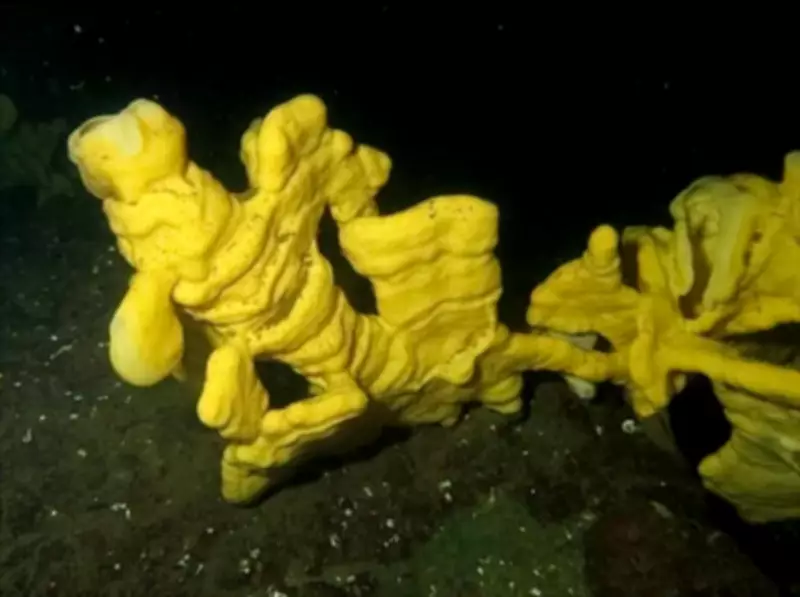
For many years, marine biologists would discuss glass sponge reefs in the past tense. These incredible and fragile undersea formations, created by creatures that spun siliceous skeletons, were considered ancient structures from the age of dinosaurs. Textbooks claimed these communities became extinct millions of years ago. However, nature always likes to surprise us. While exploring mysterious sonar readings, scientists discovered a huge living reef of glass sponges far beneath the freezing waters of British Columbia's sea.
Discovery Shocks Scientific Community
The finding came as a huge surprise to the scientific community. It turns out that we did not lose the prehistoric glass towers of the sea to oblivion; we simply did not know where to look. This discovery changes our perception of what the contemporary ocean can hide in terms of secrets. The oldest and most sophisticated ecological design systems have continued to operate in the depths of the ocean.
How Glass Sponge Reefs Form
To fully appreciate the significance of this discovery, one must understand the unique way in which these reefs come to be. Glass sponge reefs are not merely heaps of ancient remains. They represent a complex multigenerational process during which living organisms constantly die and give way to their skeletons, which act as foundations for future generations. In the unstable seafloor environment, the glassy skeleton provides a stable basis.

An interesting scientific paper in Scientific Reports helps reveal the mysteries of this unique phenomenon. The findings describe how free-swimming larvae of glass sponges travel deep underwater and settle directly on the fused remains of their predecessors. Year after year, new generations of sponges grow upwards and sideways, transforming a seemingly dead area into a thriving biological structure. Without these growing layers of living sponges constantly enlarging the framework, the whole structure would collapse. However, in reality, these frameworks evolve into massive ecosystems capable of lasting for thousands of years.
Adaptation to Deep-Sea Currents
What helped this ancient type of reef withstand several extinction events that killed off most other creatures? The answer is high efficiency and excellent adaptation to deep-sea currents. Glass sponges are great filter feeders, allowing huge amounts of water to flow through their bodies and filter tiny particles of nutrients.
The mechanisms keeping them well-fed are explored in a comprehensive study published in Scientific Reports titled "Trophic ecology of glass sponge reefs in the Strait of Georgia, British Columbia." The researchers found that these reefs are deeply intertwined with modern ocean movements and sediment dynamics. Instead of being isolated from the world above, the sponges survive by intercepting organic matter and plankton flowing down from the upper ocean. The reefs exist today because they found a perfect geographic sanctuary where local currents consistently deliver the exact food supply they need to thrive.
Implications for Ocean Exploration
This discovery is a powerful illustration of just how little we know about our own planet. The waters of the Pacific are notoriously hard to map, and it is all too easy to confuse a thriving ecosystem with a mere piece of rock when looking at a typical sonar display. By demonstrating that a supposedly extinct prehistoric environment was still alive, the reefs off Canada's coast offer a valuable lesson for all explorers yet to come. It proves that the deep waters of the sea are far from being a silent relic of the past, but rather a place where history is rewritten every single day.