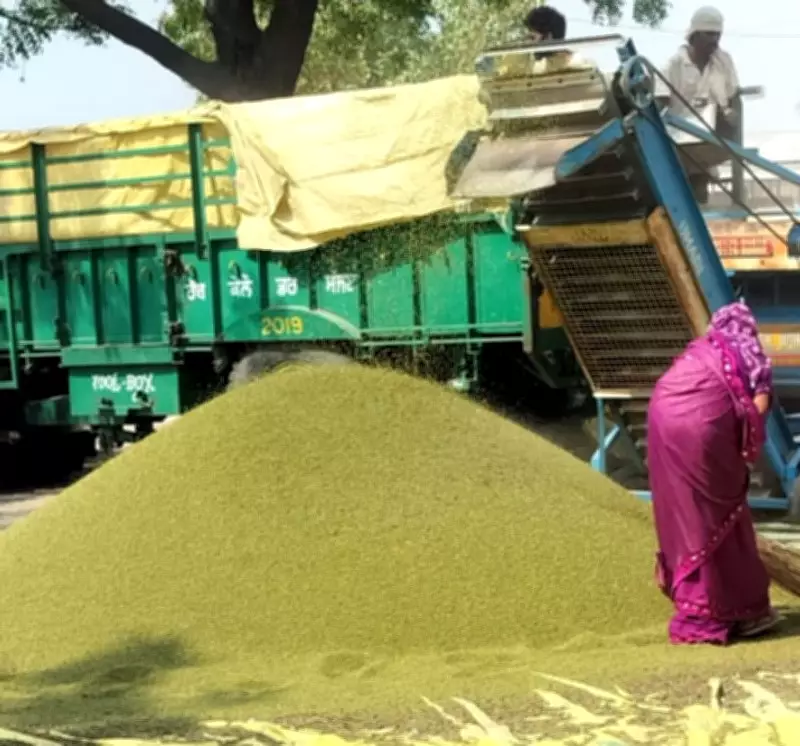
Moong (green gram) is fetching Rs 8,200 per quintal at the Kotkapura grain market, marking a sharp increase of nearly Rs 2,000 compared to last year's rates. This surge is expected to significantly boost crop diversification efforts in the Faridkot region of Punjab.
Record arrivals and attractive prices
The Kotkapura mandi has already recorded arrivals of nearly 4,500 to 5,000 bags (each weighing 50 kg) of moong this season. On Saturday, the crop traded at Rs 8,100 to Rs 8,200 per quintal, against a maximum price of Rs 6,100 per quintal last year. Notably, the current arrivals already match the total quantity received during the entire marketing season last year, indicating that this year's yield and arrivals are likely to surpass previous records comfortably.
Umesh Garg, President of the Arhtiya Association, Kotkapura, said, “The pace of arrivals this year has been remarkable. Going by current trends, the season’s total is expected to far exceed last year’s figures.”

Market dynamics and quality
Unseasonal rains earlier this season slightly affected the quality of the crop, making the grain marginally lighter. However, this has not dampened market sentiment. Local processing units and traders have been actively procuring the produce, keeping daily trading volumes brisk.
The biggest draw for farmers this season is the price. Moong is currently fetching around Rs 8,100 per quintal in the open market, a jump of nearly Rs 2,000 per quintal over last year’s average price of Rs 6,100, Garg added.
Above MSP and strong private demand
Interestingly, the minimum support price (MSP) fixed by the Centre for moong stands at Rs 6,700 per quintal. However, the crop is trading well above the floor price due to strong private and commercial demand. Although government agencies do not actively procure this pulse, brisk private trade—driven by local processing mills and buyers from outside the state—has ensured highly profitable returns for growers, said Sanjay Mitta, an arhtiya in Kotkapura.
Traders pointed out that last year, prices rallied further by Rs 500 to Rs 600 per quintal as the season progressed. A similar trend this year could mean even better returns for farmers in the coming weeks.
Impact on crop diversification
The combination of good yield and strong prices is being seen as a major boost for farmers in a state that has long been trying to move away from the water-guzzling wheat-paddy cycle. Pulses such as moong require significantly less water, enrich the soil with nitrogen, and have a much shorter crop cycle compared to paddy, according to agriculture experts in the area.
The current profitability of the crop is likely to encourage more farmers to bring larger areas under pulse cultivation in the coming seasons, added the traders.
Varieties and returns
The market currently has a mix of the early-sown “Saathi” variety (a 60-day duration crop) and the standard moong variety. While Saathi is trading at a discount of Rs 100 to Rs 150 per quintal compared to the standard variety, overall returns across both remain attractive. This development is being seen as a positive sign for Punjab’s crop diversification efforts.