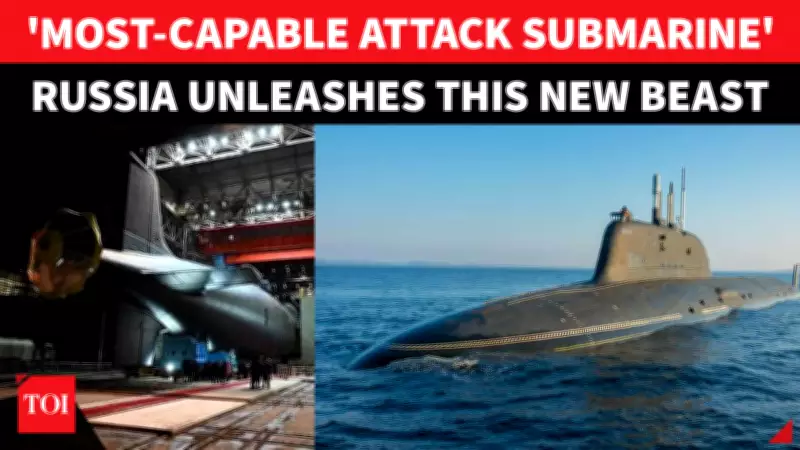
Amid ongoing constraints across its broader military industrial sector, Moscow has intensified its focus on its most formidable strategic asset: the fourth-generation nuclear submarine program. The Sevmash Shipyard recently hosted a high-profile keel-laying ceremony for the Murmansk, marking the official start of construction on the ninth hull of the modernized Project 885M Yasen-M class multi-purpose attack fleet.
Russia's Submarine Fleet Modernization
The Kremlin has committed to a sweeping structural shift, intending to phase out legacy Soviet-era attack submarines entirely in favor of an all-Yasen and Yasen-M fleet by 2035. This ambitious plan underscores Russia's determination to maintain a cutting-edge underwater capability despite broader industrial challenges.
Advanced Capabilities of the Yasen-M Class
The strategic anxiety radiating through NATO naval headquarters stems directly from the Yasen-M's combination of extreme acoustic isolation and lethal payload versatility. Featuring advanced raft-mounted internal machinery, conformal hydrophone arrays, and a highly compact KTP-6 monoblock reactor, the Murmansk is built to blend seamlessly into ocean background noise.

Russian commanders no longer need to sneak past the heavily monitored GIUK (Greenland-Iceland-UK) Gap to hold European infrastructure or transatlantic supply lanes at risk. This effectively neutralizes the West's classic Cold War barrier defense model and forces the US Navy to confront an escalating dual-theater subsurface challenge in both the Atlantic and Pacific oceans.
Implications for NATO
The new submarine's stealth and versatility pose a direct threat to NATO's maritime strategy. With the ability to operate undetected in vast ocean areas, the Yasen-M class can target critical infrastructure and naval assets, complicating alliance defense planning. The Murmansk's construction signals Russia's long-term commitment to undersea warfare dominance, prompting NATO to reassess its anti-submarine warfare capabilities and posture.
As the geopolitical landscape remains tense amid the Ukraine crisis, the launch of the Murmansk adds another layer of complexity to East-West relations. The submarine program exemplifies Russia's strategic prioritization of naval power, even as other sectors face constraints.