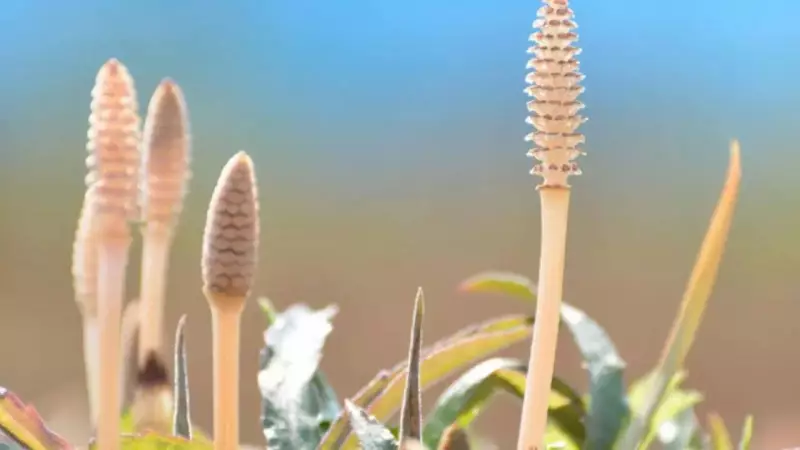
In a remarkable discovery that bridges botany and climate science, researchers have found that a humble, ancient plant holds a chemical secret that could rewrite our understanding of Earth's prehistoric atmosphere. The study focuses on horsetails, a lineage of flora that has survived for over 400 million years, and reveals their extraordinary ability to filter water in a way never before seen on our planet.
An Isotopic Signature Mistaken for Alien
The scientific journey began at the Rio Grande in New Mexico, where a team analyzed smooth horsetails. They tracked changes in oxygen isotopes—chemical tracers in water—as it moved from the plant's base to its summit. To their astonishment, the isotopic values in the water at the top of the horsetails were shockingly low. These values were far lower than any ever recorded elsewhere on Earth and were remarkably similar to isotopic signatures often found in meteorites. This finding was so unusual that it could have been mistaken for an extra-terrestrial signal.
Horsetails, whose prehistoric ancestors stood nearly 30 metres tall, have survived multiple mass extinctions and climatic shifts. Their modern versions are smaller but retain an ingenious internal engineering. Their hollow, jointed stems move water through countless microscopic holes, a natural filtration system so efficient it has yet to be replicated in any laboratory.

Nature's Humidity Recorders: The Phytolith Phenomenon
The key to the horsetails' climate-recording power lies in microscopic, silica-based structures they produce called phytoliths. These durable particles preserve the plant's internal oxygen isotope ratios for millions of years after fossilization. Essentially, each phytolith acts as a tiny, ancient humidity gauge, locking in a chemical snapshot of the atmosphere in which the plant lived.
This discovery is a breakthrough for paleoclimatology, especially for studying arid environments. The process of transpiration—where plants release water vapor—affects lighter and heavier oxygen isotopes differently. Horsetails exhibit an unparalleled natural ability to separate these isotopes, stripping away the heavier ones. This explains the bizarre isotopic readings long observed in other desert plants and provides a new tool to simulate ancient evaporation rates and humidity levels.
Unlocking Earth's Deep Climatic History
The implications of this research are profound. By combining studies of living horsetails with data from fossilized phytoliths, scientists can now probe deep into Earth's climatic past with unprecedented detail. Researchers believe these phytoliths could help determine atmospheric moisture levels from the age of the dinosaurs, a period for which direct climate data is scarce.
What began as an investigation into a puzzling isotopic anomaly has positioned the humble horsetail as an improbable but persuasive witness to planetary history. This 400-million-year-old survivor is now guiding scientists toward a clearer picture of lost worlds, offering vital clues about how plants adapt to extreme aridity and how our planet's climate has transformed over eons.