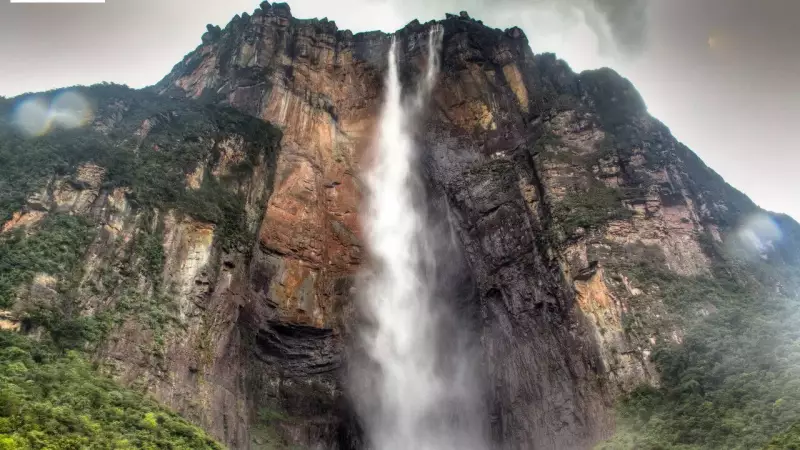
The thunderous roar and powerful plunge of a waterfall are sights that captivate millions. Yet, the world's tallest waterfall, Venezuela's Angel Falls, presents a breathtaking paradox. Visitors who witness its majesty from the base are met not with a crashing torrent, but with a gentle, pervasive mist. The water, it seems, vanishes into thin air before ever touching the ground.
The Physics of Disappearing Water
This phenomenon is not magic, but a spectacular demonstration of physics, scale, and atmospheric resistance. Angel Falls begins its descent from the summit of Auyantepui, a massive tabletop mountain. The water plummets for an uninterrupted 979 meters (approximately 3,212 feet). Over such an immense distance, the forces of air and wind become dominant players.
As the single stream of water begins its kilometre-long fall, it immediately encounters powerful resistance. Layers of moving air press against it from all sides—wind shears it horizontally, while updrafts push upward against its descent. This relentless atmospheric pressure stretches and pulls the cohesive stream apart. What starts as a unified flow soon fractures into strands, then into countless individual droplets.

Transformation into a Drifting Cloud
The longer the fall, the more pronounced this disintegration becomes. By the time the water is halfway down the cliff face, it is no longer a liquid column. The droplets become so fine that they behave more like fog or a dense spray. Sunlight and warmer temperatures cause further evaporation, thinning the cascade even more. On particularly windy days, the mist is carried sideways, showering the surrounding jungle canopy.
From a distance, the waterfall appears as a delicate, endless silver thread. Up close, the experience is one of a cool, drifting cloud. Visitors often find themselves dampened by a fine spray without witnessing a concentrated point where water violently impacts the earth. The expected thunderous pool at the base is replaced by scattered moisture and smaller, gentler streams that form further down the rock face.
Ecological Impact of the Eternal Mist
So, does any water actually reach the bottom? The answer is yes, but in a radically diffused form. The energy of the fall is dissipated over a vast area. Instead of a single, powerful impact, the moisture arrives softly and spread out. This constant, gentle precipitation shapes a unique micro-ecosystem.
The perpetual mist from Angel Falls acts as a life-giving veil for the surrounding rainforest. It coats leaves, rocks, and soil, maintaining a high level of humidity that fosters the growth of moisture-loving plants like mosses, ferns, and orchids. The air remains thick and damp, supporting a biodiversity that thrives on this indirect hydration. In essence, the waterfall doesn't feed just one pool; it irrigates an entire section of the jungle through its aerial transformation.
The majestic Angel Falls, therefore, challenges our classic image of a waterfall. Its immense height forces the water into a slower, more graceful interaction with the planet. It is a stunning reminder that in nature, scale can fundamentally alter behavior, turning a powerful plunge into a pervasive, life-sustaining mist.