In a landmark move for urban renewable energy, Chandigarh has officially kickstarted its first large-scale solar power initiative targeting government buildings. The Chandigarh Renewable Energy and Science and Technology Promotion Society (CREST), under the Union Territory administration, has issued a tender to select an agency for installing solar panels on 96 buildings owned by the Municipal Corporation (MC).
A Pioneering RESCO Model for Government Infrastructure
This project is groundbreaking as it is the city's first major solar energy venture to be executed under the Renewable Energy Service Company (RESCO) framework. The journey to this point involved over a year of meticulous preparation, including extensive paperwork for the tender document and the signing of a crucial memorandum of understanding (MoU) between the MC and CREST.
The selected company will be contracted for a period of 25 years. Under the innovative RESCO model, the chosen agency will bear the entire investment required for setting up the solar plants on the identified rooftops. This ensures that the Municipal Corporation does not incur any upfront capital expenditure, with CREST acting as the project facilitator.

Financial and Environmental Benefits for the City
The power generated from these solar installations will be sold to Chandigarh Power Distribution Limited (CPDL) at a tariff of Rs 4.10 per unit, as per the Average Power Purchase (APP) rate. Additionally, in a significant revenue-generating model, the operating company will pay the MC between Rs 0.50 to Rs 0.60 per unit of electricity generated.
This arrangement is expected to yield an annual revenue of Rs 19 lakh to Rs 20 lakh for the civic body, achieved simply by leasing its rooftop space for the contract duration. According to CREST estimates, the entire project will involve an investment of around Rs 15 crore.
On the environmental front, the installations are projected to have a combined capacity of 3 megawatts, producing approximately 39 lakh units of clean energy annually. All maintenance and operational responsibilities will lie with the selected company for the entire 25-year contract period.
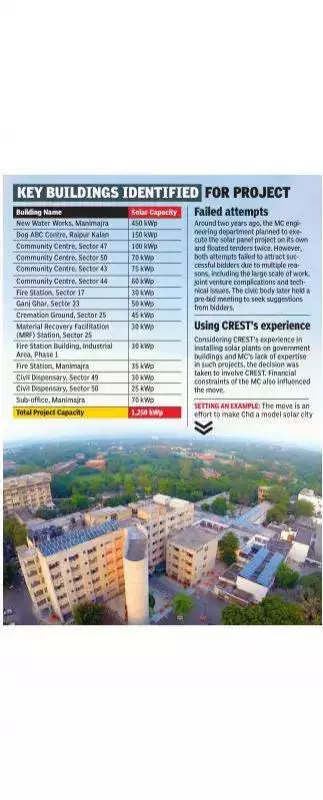
Key Buildings Identified for Solar Power
The project encompasses a diverse set of MC buildings across the city. Some of the major sites and their planned solar capacities include:
- New Water Works, Manimajra: 450 Kilowatts peak (Kwp)
- Dog ABC Centre, Raipur Kalan: 150 Kwp
- Community Centre, Sector 47: 100 Kwp
- Community Centre, Sector 50: 70 Kwp
- Fire Station, Sector 17: 30 Kwp
- Ganj Ghar, Sector 23: 50 Kwp
- Cremation Ground, Sector 25: 45 Kwp
Other buildings include various community centres, fire stations, civil dispensaries, and material recovery facilities.
A Vision for a Model Solar City
Navneet Srivastava, CEO of CREST, emphasized the project's strategic importance, stating that the tender was floated to equip the 96 MC buildings with solar energy. He highlighted that this is the first time a RESCO model solar project is being implemented for a government building in Chandigarh, with the overarching goal of transforming the city into a model solar city.
A senior officer involved in the project reiterated the financial advantage for the MC, noting, "Under the RESCO model, the selected company will make the entire investment... and the MC will not have to spend even a single penny on the project."
This initiative marks a significant step forward in Chandigarh's sustainable development agenda, leveraging a public-private partnership model to promote renewable energy, reduce the carbon footprint of civic operations, and create a new revenue stream for urban local bodies.