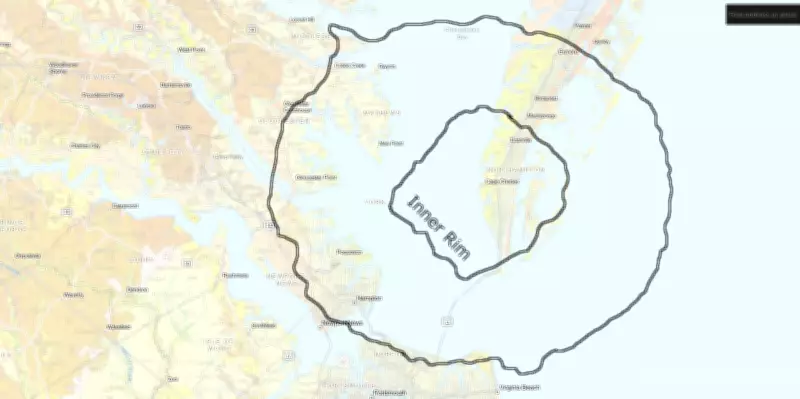
If you visited the shorelines of the Chesapeake Bay today, you would find a beautiful vista of salt marshes, oysters, and ships in constant motion. This bay is an important part of American heritage, but beneath its serene surface lies a shocking truth that few know about. According to scientists, this entire area sits above one of the largest cataclysms to ever occur on Earth.
The Formation of a Hidden Giant
More than 35 million years ago, a mountain-sized object from space slammed into the shallow waters of the Atlantic shelf. The resulting explosion was so powerful that it carved out a hole nearly 53 miles wide and several miles deep. Today, that giant wound is known as the Chesapeake Bay impact crater, and it remains one of the largest and most significant impact structures in the United States.
What is even more astounding is that this giant impact crater is invisible to the naked eye. For comparison, Meteor Crater in Arizona is a prominent landmark with a visible bowl-like structure. However, unlike its famous counterpart, the Chesapeake crater is completely covered by layers of rock and other matter. Millions of years of erosion by rivers and oceans resulted in thousands of feet of sand and dirt settling above the point of impact, hiding the evidence from sight.

The Drilling Project That Exposed the Evidence
It took scientists much more than just looking at a map or taking a walk across the area to conclude that an impact crater exists here. The truth was only revealed when drilling went as deep as five thousand seven hundred feet beneath the Earth's surface. This project exposed all the elements that make up the anatomy of a disaster: melted glass, broken rock formations, and even fractured granite.
One particularly important scientific paper, written by scientists from the USGS, describes how drilling was absolutely critical in transforming the anomaly detected on the map into an undeniable truth. It enabled scientists to obtain rock samples in order to prove scientifically that the formation of "shocked" minerals can take place only under the influence of extreme pressure, such as that generated by an asteroid impact.
However, the crater is not just a relic of ancient history; it still plays an important role in the lives of people living in Virginia and Maryland today. The power of the impact was so great that it destroyed the geological structures below, forming a massive "rubble zone" that serves as an enormous underground wall. This rubble zone still defines the direction of water flow through the area and makes water hunting quite difficult in coastal regions. This ancient wound, buried under thousands of feet of sediment, continues to influence water flow and land subsidence in the region, revealing the enduring power of a cataclysmic event.
A 35-Million-Year-Old Water Mystery
Perhaps the strangest thing discovered through deep drilling research was water. In the depths of the crater, researchers found water that was two times saltier than today's oceans. It is not recent seawater that leaked into the underground structures; it is a chemical fossil. This is the finding of a study conducted by researchers at the University of Tokyo and reported in the scientific journal Nature. Due to the impact, the water has been effectively "caged" for millions of years. The water, according to the scientists, is actually the brine of oceans that existed millions of years ago. It provides a literal liquid time capsule for studying the chemistry of ancient oceans.
The existence of the crater also helps explain why certain sections of the bay are subsiding at a faster rate than others. These mixed rocks from the crater continue to sink under the pressure of the modern world, resulting in faster subsidence for regions such as Hampton Roads. This is a clear indication that the solid surface we walk on is not always as stable as it seems.
While for the millions of visitors traveling across the Chesapeake Bay Bridge-Tunnel annually, the scene seems tranquil, to scientists who have drilled more than 5,700 feet into the seabed, the bay has come to symbolize the awesome force of nature. It is an account of how one cataclysmic event from millions of years ago continues to affect our drinking water and land structures to this day.