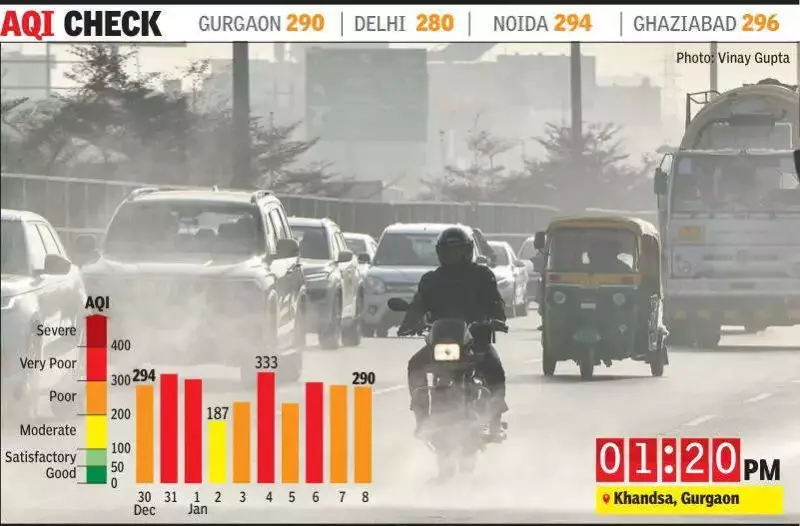
For the third day in a row, Gurgaon's air quality was classified as 'poor', posing health risks to residents. Official data for Thursday recorded an Air Quality Index (AQI) of 290, indicating a slight improvement from earlier in the week but still within the unhealthy range.
Monitoring Stations Show Varied Pollution Levels
Of the four air monitoring stations in the city, only three were operational on Thursday, revealing a patchy picture. The Sector 51 station recorded the worst air with an AQI of 326, placing it in the 'very poor' category. Meanwhile, NISE Gwalpahari reported an AQI of 298, and Vikas Sadan logged 248, both in the 'poor' range. This shows significant variation in pollution levels across different areas of the city.
The AQI for the previous two days was marginally higher, at 294 on Wednesday and 303 on Tuesday. The trend for January has shown persistently high pollution, with the AQI entering the 'very poor' category on several occasions.

Winter Conditions Trap Pollutants
Officials and experts attribute the sustained poor air quality to typical unfavorable winter meteorological conditions. Low wind speed and temperature inversion act like a lid, trapping harmful pollutants close to the ground. Brief periods of stronger surface winds over the past two days offered limited relief by helping disperse some pollutants, but the overall situation remains unstable.
According to Mohammad Rafiuddin, Programme Lead at the Council on Energy, Environment and Water (CEEW), PM2.5—fine particulate matter—becomes the dominant pollutant in winter across Delhi and its surrounding areas like Gurgaon. "In winter, PM2.5 levels rise sharply due to adverse meteorological conditions that hinder the effective dispersal of pollutants," he stated.
Rafiuddin explained that these pollutants originate from winter-specific sources like biomass heating, in addition to perennial contributors such as vehicular and industrial emissions. He emphasized that controlling these levels requires multi-sectoral interventions: "Keeping these levels in check requires interventions to curb emissions at the source across various sectors, such as eliminating biomass burning by providing cleaner alternatives, promoting clean transportation options, and expanding public transportation, among others."
Health Advisories and Unstable Forecast
Health advisories continue to warn the public about the dangers of prolonged exposure to 'poor' quality air. It can cause breathing discomfort and is particularly risky for vulnerable groups including children, the elderly, and individuals with pre-existing respiratory or heart conditions. Residents are advised to limit strenuous outdoor activities, especially during peak pollution hours in the morning and evening.
The forecast suggests that Gurgaon's air quality is likely to remain unstable in the near term. Experts say sustained changes in wind patterns are needed to effectively cleanse the air. Until then, the city must brace for continued periods of poor to very poor air quality, underscoring the urgent need for long-term solutions to the region's pollution crisis.