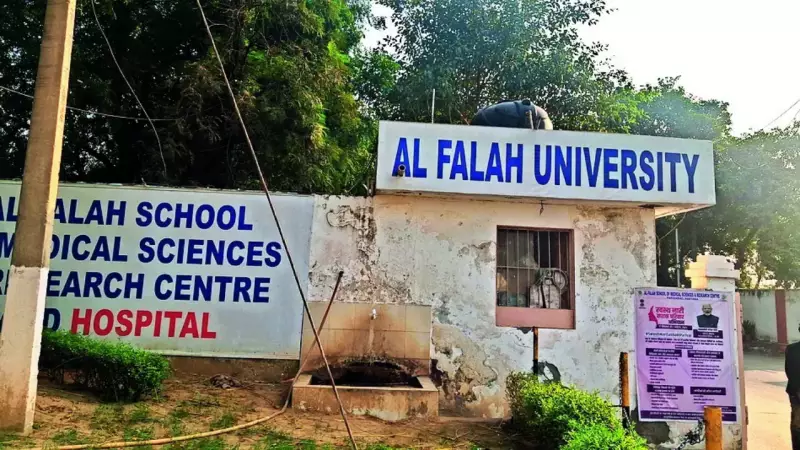
The Haryana State Pollution Control Board (HSPCB) has taken stringent action against Al-Falah University in Faridabad, ordering the immediate closure and sealing of an under-construction hostel and mess block. The action was initiated for violating Graded Response Action Plan (GRAP) restrictions and operating without mandated environmental approvals. The case came to light through an RTI reply.
Inspection Reveals Critical Lapses
According to the RTI response dated December 26, issued by HSPCB's Ballabgarh office to environmentalist Varun Gulati, a board inspection team visited the campus on November 15. The team collected samples from the inlet and outlet points of both the Sewage Treatment Plant (STP) and Effluent Treatment Plant (ETP).
The subsequent laboratory report revealed alarming breaches of prescribed environmental norms. At the ETP outlet, the Biochemical Oxygen Demand (BOD) was recorded at 92 mg/l against a permissible limit of 30 mg/l. Similarly, Chemical Oxygen Demand (COD) was found to be 472.3 mg/l (limit 250 mg/l), and Total Suspended Solids (TSS) measured 290 mg/l (limit 100 mg/l). The STP outlet also failed multiple parameters, including BOD, TSS, Total Dissolved Solids (TDS), and faecal coliform levels.

Construction During GRAP and Lack of Clearance
The inspection uncovered another major violation: active construction work on the hostel and mess block was ongoing despite GRAP-3 restrictions being in force due to severe air quality. The university, classified as a bulk waste generator, had not registered on the prescribed dust portal. Officials noted the absence of basic pollution control measures like wind-breaking walls, green nets, sprinklers, and anti-smog guns at the site.
On November 21, HSPCB ordered the immediate closure and sealing of the construction site and directed the power utility to disconnect electricity, citing directions from the Commission for Air Quality Management (CAQM).
In a separate show-cause notice dated November 28, the board alleged that the "whole university campus and associated buildings/structures" required prior environmental clearance under the EIA Notification, 2006, from the State Environment Impact Assessment Authority, which it had not obtained.
Legal Proceedings and Expert Reaction
Based on the findings, HSPCB issued a show-cause notice under Sections 43, 44, and 45A of the Water Act, warning of prosecution and environmental compensation. The board has proposed prosecution under the Water and Air Acts, action under Section 15 of the Environment (Protection) Act, 1986, and the imposition of environmental compensation as per its 2021 policy.
Environmentalist Varun Gulati, who procured the information, stated that the RTI documents pointed to serious compliance gaps. "You cannot expect the system to look the other way when you have untreated or poorly treated effluents being discharged and large construction going on during GRAP-3. The rules apply to everyone, including universities," he said.
A senior HSPCB official confirmed that the board acted on its statutory mandate. "In cases where there are violations relating to GRAP restrictions, lack of prior environmental clearance, or non-compliance with effluent standards, the board issues directions and initiates proceedings under the relevant Acts. Due process is followed in every case," the official stated.
The university, which is at the centre of a separate investigation into a terror module linked to a November 10 Delhi blast, holds a combined consent-to-operate (CTO) under the Water and Air Acts from October 1, 2024, to September 30, 2028. It is classified as a red-category "health-care establishment/projects having discharge of 100 KLD or more."