

Protected Aravali Hills in Sohna Scarred by Illegal Farmhouses and Construction
The serene slopes of the Aravali hills in Sohna, a protected ecological zone near Gurgaon, now bear the marks of blatant human intrusion. Farmhouses carved into hill slopes, swimming pools overlooking scrub forests, and paved private entry roads have transformed terrain that should legally remain untouched. This development exposes yet another round of violations in one of Delhi-NCR's most fragile environmental areas, raising serious questions about enforcement and accountability.
Golden Heights: A Case Study in Violation
In the Golden Heights area, permanent structures have emerged on land officially recorded as 'gair mumkin pahad'—non-buildable hill land. A recent visit revealed operational farm stays and recreational facilities nestled within the hill tract. The landscape now features not just farmhouses, but also boundary walls, imposing gates, paved access roads, and other permanent installations that contradict conservation mandates.
At one location, a partially constructed boundary wall rises from dense, uneven vegetation, with exposed brickwork and unfinished edges indicating recent activity. The surrounding rocky slope, dotted with native trees and shrubs, shows clear signs of being cut and cleared rather than naturally opened. Deeper within the foliage, a green-roofed structure stands as further evidence of encroachment.

From Raw Intrusion to Upscale Enclosure
Elsewhere, a finished entrance demonstrates the scale of transformation. A large metal gate set between stone-clad walls, topped with barbed wire, guards a concretized driveway carved into the hill's natural gradient. Vegetation has been cleared along the access path, and a utility pole beside the wall suggests formal service connections to the property. Further along, a fully developed frontage with plastered walls, lighted pillars, a wide gate, ornamental stonework, and a paved approach illustrates how raw intrusion has evolved into upscale private enclosure.
Satellite imagery of the area confirms multiple built-up pockets within demarcated stretches covering Golden Heights and adjoining Aravali land, including private farm stays and commercial properties.
Legal Framework and Enforcement Challenges
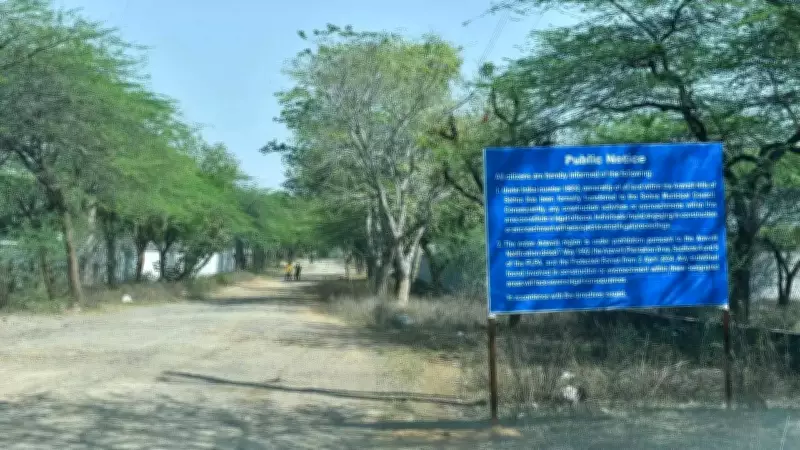
A public notice installed on the hill states that the land has been transferred to Sohna Municipal Council through 'intkaal' entry number 18932. It warns that all land covered under this mutation now vests with the civic body and that any construction or encroachment constitutes a legal offence inviting strict action. The notice cites the 1992 Aravali notification, sections 4 and 5 of the Punjab Land Preservation Act (PLPA), and protected forest provisions.
According to revenue maps, parts of this land are recorded as 'gair mumkin pahad' under general Section 4 of the PLPA, where non-forest activity is strictly prohibited. Under the Union environment ministry's Aravali notification, buildings, roads, electrification, and tree felling on such land require prior approval—a requirement clearly being flouted.
In a December 9, 2022 order, the National Green Tribunal (NGT) directed Haryana and Rajasthan governments to establish a monitoring committee and conduct periodic—preferably quarterly—reviews until all encroachments were cleared from 'gair mumkin pahad' areas in Gurgaon, Faridabad, Nuh, and Alwar.
"It is surprising that fresh construction is continuing directly under the nose of the district administration, Sohna municipal council, forest department, and town and country planning department. This is a blatant violation of NGT orders," said environmental activist SS Oberoi.
Municipal Response and Historical Context
Sohna Municipal Council chairperson Preeti Badgi stated that enforcement measures, including notices and demolition, "has been initiated after the mutation and in line with NGT orders." However, the persistence of violations suggests gaps in implementation.

This issue persists despite years of scrutiny. In an affidavit before the NGT, the Haryana State Pollution Control Board reported that Sohna Municipal Council had demolished 101 illegal farmhouses since 2020, removed boundary walls over more than 120 acres, and razed a 1.5-kilometer road. An FIR was also registered on June 23, 2025, concerning the illegal road.
In an action-taken report filed on July 10, the council noted that notices had been issued to 330 farmhouse owners in Raisina and Golden Heights following a Punjab and Haryana High Court order dated June 3, 2020. Yet, the ongoing construction indicates that legal actions have not fully deterred violators.
Ecological Implications and Future Concerns
The Aravali hills serve as a critical ecological barrier against desertification and play a vital role in groundwater recharge for the Delhi-NCR region. Illegal construction not only disrupts this fragile ecosystem but also sets a dangerous precedent for further encroachments. The conversion of 'gair mumkin pahad' into private enclaves threatens biodiversity, increases soil erosion, and compromises the region's environmental resilience.
As authorities grapple with enforcement, the situation in Sohna highlights the ongoing tension between development pressures and conservation imperatives in rapidly urbanizing landscapes. The need for stricter monitoring, swifter punitive actions, and greater public awareness about the ecological significance of the Aravalis has never been more urgent.





