US Military Observes Sharp Reduction in Iranian Firepower as Conflict Intensifies
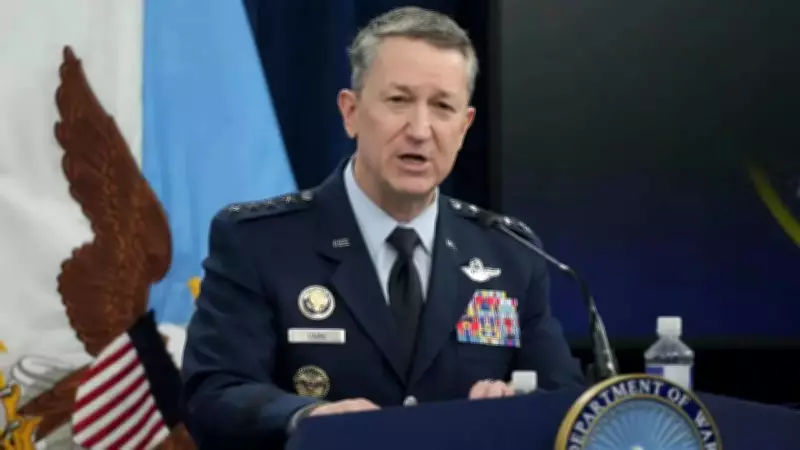
The United States' top military officer, General Dan Caine, chairman of the Joint Chiefs of Staff, announced on Wednesday that Iran has significantly reduced its missile and drone attacks compared to the initial days of the war that began on Saturday. Despite this decline, Washington has signaled an expansion of its offensive operations deeper into Iranian territory, marking a critical escalation in the ongoing conflict.
Drastic Drop in Iranian Ballistic Missile and Drone Launches
According to General Caine, speaking at a Pentagon briefing, the number of ballistic missiles fired by Iran has plummeted by 86% from the levels recorded on Saturday. Over the past 24 hours alone, there has been a 23% decline in such launches. Additionally, one-way attack drone launches have decreased by 73% since the conflict's outset, as reported by the Associated Press.
Some military analysts speculate that Iran may be conserving its arsenal to prolong the war, rather than facing a depletion of resources. This strategic shift comes as the conflict has already resulted in over 1,000 fatalities in Iran, more than 50 in Lebanon, and approximately a dozen in Israel, according to official statements from these nations.

US Expands Offensive and Claims Naval Victory
General Caine emphasized that US forces will now begin to expand inland strikes progressively deeper into Iran, aiming to create additional freedom of maneuver for American military operations. In a related development, US Defense Secretary Pete Hegseth asserted that the United States is prevailing in the war, despite confirming the deaths of six American troops so far.
Hegseth, quoted by Reuters, stated, "The United States will outlast Iran." He also confirmed a significant naval engagement, revealing that a US submarine sank an Iranian warship off the coast of Sri Lanka. This incident, described as the first sinking of an enemy vessel by torpedo since World War Two, involved the Iranian warship Dena being struck by a single Mark 48 torpedo from a US Navy fast-attack submarine.
Conflict Widens Across the Region with Civilian and Economic Impacts
The war has rapidly expanded beyond Iran's borders, with Israel conducting strikes in Tehran and targeting the Iran-backed Hezbollah group in Lebanon. Iran, in retaliation, has launched missiles at Bahrain, Kuwait, and Israel. Turkey reported that NATO defenses intercepted a ballistic missile from Iran before it could enter Turkish airspace, while a Malta-flagged merchant ship was struck in the Strait of Hormuz, leading to a rescue operation by Oman's navy.
Iranian President Masoud Pezeshkian defended Tehran's actions, stating on social media platform X that Iran pursued diplomacy but was forced into self-defense following US and Israeli attacks. He emphasized respect for neighboring countries' sovereignty and called for collective efforts to achieve regional stability.
The humanitarian toll is severe, with mass displacement reported in Lebanon. Authorities and UNICEF indicate that over 83,000 people have been uprooted, including nearly 60,000 in the last 24 hours alone, of which about 18,000 are children. In Tehran, residents describe emptier streets, heavy smoke, and intermittent anti-aircraft fire as strikes intensify.
Economically, the conflict has triggered shockwaves, with oil prices surging due to Iranian attacks on traffic through the Strait of Hormuz. Global stock markets have been rattled amid fears that rising energy costs could slow the global economy.
US Policy and Future Outlook
Despite the escalating violence, the White House has stated there are currently no plans to deploy US ground troops into Iran. White House press secretary Karoline Leavitt clarified, "It's not part of the current plan, but I'm not going to remove an option for the president that is on the table." This stance underscores the complex strategic calculations as the conflict continues to evolve, with potential implications for regional and global stability.