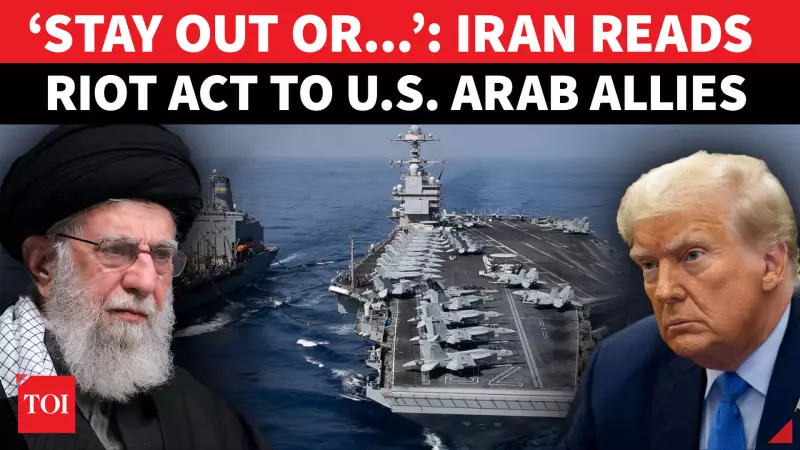
Iran Issues Stark 'No Mercy' Warning to Arab Nations Over Potential U.S. Attack
In a dramatic escalation of regional tensions, Iran has delivered a forceful warning to neighboring Arab countries, explicitly stating they will face severe consequences if their territories are utilized in any military action against the Islamic Republic. The provocative statement, characterized by the phrase 'No Mercy, Only Bombs', underscores Tehran's uncompromising stance as geopolitical friction intensifies across the Middle East.
Military Movements and Diplomatic Rhetoric Heighten Standoff
The warning coincides with significant military deployments, most notably the movement of the USS Abraham Lincoln aircraft carrier strike group into strategic Middle Eastern waters. This naval advancement represents a tangible show of force by the United States, amplifying concerns about a potential armed confrontation. Iranian President Masoud Pezeshkian has vehemently accused Washington of deliberately fueling regional instability through such provocative actions.
Contradictory Signals from Washington and Tehran
Amid the bellicose exchanges, a complex picture of diplomacy emerges. U.S. President Donald Trump has publicly claimed that Iran remains interested in negotiations, even as his administration maintains substantial military pressure. Conversely, Iranian officials have acknowledged that limited communication channels between senior U.S. and Iranian representatives persist behind the scenes, suggesting that dialogue, however fragile, has not been entirely severed despite the public war of words.

Regional Security Implications and Broader Context
The Iranian warning places neighboring Arab states in a precarious position, potentially forcing them to choose sides in a growing U.S.-Iran confrontation. This development occurs within a broader regional security crisis, where incidents in the Gulf, activities of proxy groups, and great power rivalries continuously threaten to erupt into wider conflict. The presence of the USS Abraham Lincoln serves as a constant reminder of the high stakes involved and the ever-present risk of miscalculation.
The situation remains fluid and dangerously volatile. Analysts warn that any incident, whether accidental or deliberate, could trigger a rapid and uncontrollable escalation, drawing multiple regional actors into a conflict with global repercussions. The international community watches with apprehension as rhetoric hardens and military assets converge in one of the world's most strategically vital and unstable regions.