

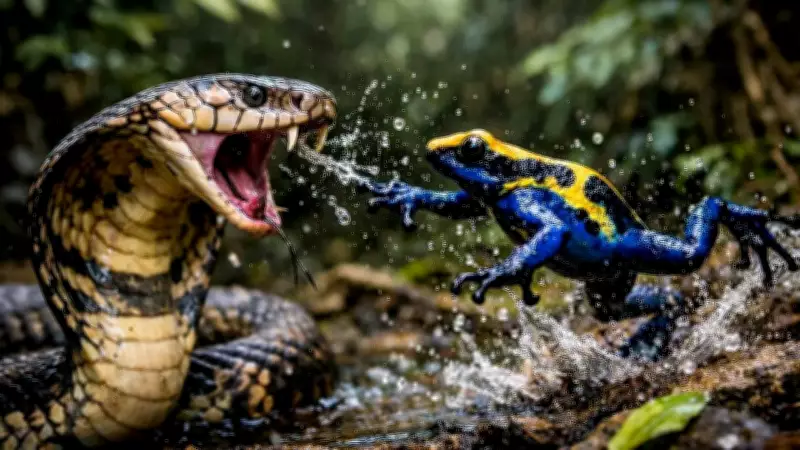
King Cobra vs Poison Dart Frog: A Fascinating Wildlife Showdown
The hypothetical confrontation between a poison dart frog and a king cobra has captured significant attention online, sparking curiosity as an intriguing wildlife face-off scenario. Both animals are highly distinct from one another, yet they share a common trait: the lethal prowess that defines their survival strategies. One is a small, colorful amphibian that employs poisonous substances through its skin, while the other is a massive, swift reptile renowned as one of the deadliest venom-delivery systems in the animal kingdom. The core question driving this comparison is who would emerge victorious in such an unlikely encounter. Although such an event is highly improbable due to their geographic separation, analyzing their capabilities offers valuable insights into nature's diverse defense mechanisms.
Understanding Physical Characteristics and Defense Mechanisms
The poison dart frog is a tiny amphibian, rarely exceeding several centimeters in size. Its vibrant coloring serves as a visual warning to potential predators, indicating the presence of toxic substances in its skin. These toxins function as a passive form of defense; they are not injected but can cause harm through contact or ingestion. For instance, touching or attempting to eat this amphibian could expose a predator to poisonous compounds that disrupt nerve and muscle functions, potentially leading to paralysis or death.
In contrast, the king cobra utilizes an active mechanism for both protection and hunting, delivering its venom through specialized fangs. Its venom is primarily composed of neurotoxins, which target the neurological functions of its prey, causing rapid immobilization. Additionally, the king cobra holds the title of the largest venomous snake species, capable of delivering relatively high doses of venom in a single strike, making it a formidable predator in its ecosystem.

Size and Physical Advantages in a Confrontation
The discrepancy in size between these two animals is quite notable and would play a critical role in any hypothetical confrontation. The poison dart frog is significantly smaller and more physically frail, whereas the king cobra can measure several meters in length and possesses remarkable speed and agility. The striking speed of a cobra is exceptionally high, making it difficult for the poison dart frog to react in time to defend itself. This combination of effective striking ability and efficient movement would likely enable the snake to quickly immobilize its opponent, leveraging its physical superiority to dominate the encounter.
Toxin vs Venom: Complexity in Defense Strategies
The relationship between toxin and venom adds another layer of complexity to this comparison. The toxins produced by poison dart frogs are secreted on their skin and are poisonous upon contact or ingestion. If a predator, such as a king cobra, were to bite the frog, these toxins might affect it, depending on the predator's physiological resistance. It is important to note that some animals have evolved resistance to certain toxins, while others are highly vulnerable. Unfortunately, there is no scientific evidence regarding the specific effects of poison dart frog toxins on king cobras, leaving this aspect of the confrontation uncertain and speculative.
Natural Habitats and Geographic Separation
From a practical standpoint, such a confrontation is hard to imagine due to the distinct geographic ranges of these species. Poison dart frogs inhabit Central and South American countries, thriving in tropical rainforests, whereas king cobras are found in certain areas of Asia, including forests and agricultural lands. Their territories are totally separate, making any real-world encounter highly unlikely. Thus, this comparison remains purely hypothetical, serving as a thought experiment rather than a realistic scenario.

Who Would Win in a Hypothetical Fight?
In an engagement between these two animals, the king cobra could be expected to emerge victorious, owing to its advantages in body size, speed, and active venom delivery. It would likely use these features to overcome the frog quickly, minimizing the risk of exposure to the frog's toxins. However, an element of doubt persists regarding what might happen if the frog's toxins take effect after contact or consumption. This uncertainty highlights the unpredictable nature of wildlife interactions, even in theoretical analyses.
Ultimately, this exploration demonstrates how two completely distinct defense mechanisms—passive toxins and active venom—can be used for protection against threats, showcasing the incredible diversity and adaptability of life on Earth. It underscores the importance of understanding animal behaviors and adaptations, even in speculative contexts, to appreciate the complexities of the natural world.





