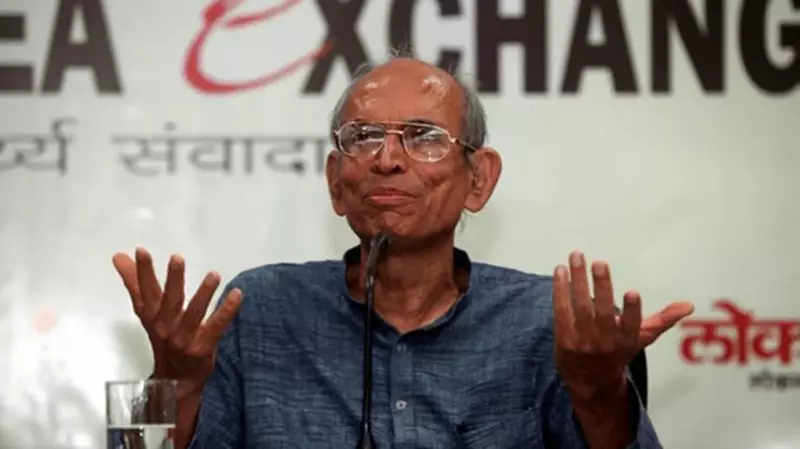
The world of Indian environmental science and activism lost a towering figure with the passing of Madhav Gadgil at the age of 83. Renowned as the architect of the landmark Western Ghats Ecology Expert Panel (WGEEP) report, Gadgil spent over five decades shaping the nation's understanding of its forests, biodiversity, and ecological limits. He firmly believed that the health of the environment was inseparable from the principles of democracy and social justice.
The Life and Legacy of a People's Scientist
Born in Pune in 1942 to economist Dhananjay Ramchandra Gadgil, Madhav Gadgil was steeped in academia from a young age. After completing his doctorate from Harvard University in 1969, he made a conscious decision to return to India, bucking the trend of pursuing careers abroad. His commitment to building indigenous scientific capacity led him to establish the Centre for Ecological Sciences at the Indian Institute of Science, Bengaluru, in 1983, which he nurtured into a world-class research hub.
His prolific output included more than 250 scholarly articles and several seminal books. His contributions were recognized with India's Padma Shri (1981) and Padma Bhushan (2006), alongside international honours like the Tyler Prize for Environmental Achievement (2015) and the Volvo Environment Prize. In 2024, the United Nations Environment Programme fittingly named him a Champion of the Earth, cementing his status as a true "people's scientist."

Gadgil's most public and impactful role came as the chairman of the Western Ghats Ecology Expert Panel in 2011. The panel's groundbreaking report recommended classifying over 66% of the mountain range as Ecologically Sensitive Areas (ESAs), calling for strict restrictions on destructive activities like mining, quarrying, large dam projects, and unchecked construction. Though initially ignored by authorities, the report's dire warnings were tragically validated by catastrophic floods and landslides in the following years.
Five Foundational Reads by Madhav Gadgil
Gadgil's written work remains the most accessible gateway to his profound ideas. Here are five essential books that capture the essence of his thought and his lifelong mission to bridge science, society, and sustainability.
1. A Walk Up the Hill: Living with People and Nature (2023)
This autobiography, available in nine languages, is a sweeping narrative of India's environmental movement over six decades. It begins with a childhood meeting with the legendary ornithologist Salim Ali and traces Gadgil's journey from Harvard to becoming India's foremost ecologist. The book offers frank reflections on his principled standoffs with authority, his deep collaborations with local communities, and the challenging path of advocating for ecological truth in the face of power. It stands as an inspiring record of a life wholly dedicated to ecological justice.
2. This Fissured Land: An Ecological History of India (1992, with Ramachandra Guha)
Co-authored with historian Ramachandra Guha, this book is a foundational text in Indian environmental studies. It examines how centuries of social hierarchy, colonial resource extraction, and post-independence policies have fractured India's landscapes. The central argument—that environmental conflicts arise from starkly unequal access to natural resources—became a cornerstone of Gadgil's entire philosophy. It is essential reading for anyone seeking to understand how contemporary ecological crises are deeply rooted in historical patterns of injustice.

3. Ecology and Equity: The Use and Abuse of Nature in Contemporary India (1995, with Ramachandra Guha)
Building on their earlier collaboration, Gadgil and Guha present a powerful analytical framework for India's environment-versus-development debates. They categorize Indian society into "ecosystem people" (those dependent on local natural resources) and "omnivores" (those who draw wealth from multiple ecosystems). The book argues that the conflict between these groups is a primary driver of ecological degradation. A crucial read for activists and policymakers, it demonstrates that true sustainability requires equitable resource distribution, not just technological fixes.
4. Ecological Journeys: The Science and Politics of Conservation in India (2005)
This collection brings ecology to life through vivid accounts of Gadgil's fieldwork, from the sacred groves of Maharashtra to the elephant corridors of Karnataka. The book illustrates how conservation efforts succeed or fail based on their engagement with local knowledge and communities. Seamlessly blending scientific observation with sharp political analysis, it reveals Gadgil's core conviction: effective and lasting conservation is rooted in democratic decision-making and active community participation.
5. India: A Lifescape: Butterflies of Peninsular India (2000, with Krushnamegh Kunte)
As the first volume in the pioneering India Lifescape series, this beautifully illustrated guide reflects Gadgil's dedication to making science accessible to all. Co-authored with Krushnamegh Kunte, it combines detailed taxonomy, ecology, and conservation notes with stunning colour plates. The book invites naturalists, students, and enthusiasts to appreciate and help protect India's rich butterfly diversity. It perfectly embodies his mission to connect expert knowledge with public wonder and stewardship.
A Moral Compass for India's Environment
Madhav Gadgil's legacy is not confined to reports or academic papers; it is a living philosophy. He consistently championed the idea that ecological wisdom must guide public policy and that local communities, as the closest custodians of nature, must be central to its governance. His work provides a moral and scientific compass for navigating India's complex environmental challenges. Through his books and his lifelong example, Gadgil has left an indelible blueprint for a future where ecological integrity and social equity advance hand in hand.