

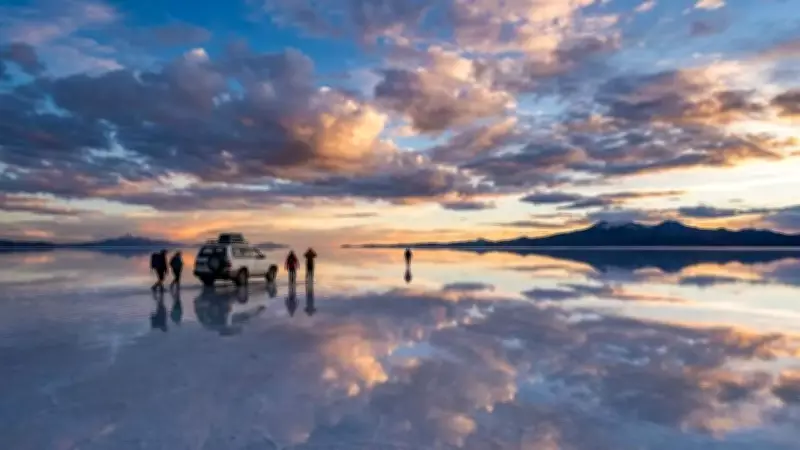
Bolivia's Salar de Uyuni: The World's Largest Natural Mirror
Located high in the Andes Mountains of Bolivia, South America, the Salar de Uyuni stands as a breathtaking geological marvel. This immense salt flat, spanning over 10,000 square kilometers, represents the remnants of ancient prehistoric lakes that have evaporated over millennia. During the dry season, it appears as a vast, flat white expanse of crystalline salt crust, creating an otherworldly landscape that attracts visitors from across the globe.
The Transformation into a Perfect Natural Mirror
What makes the Salar de Uyuni truly extraordinary is its annual transformation during the rainy season from December to April. When rainfall and mountain runoff collect on the impervious salt crust, they create a shallow, uniform layer of water only a few centimeters deep. This thin aquatic covering turns the entire salt flat into what is essentially the world's largest natural mirror.
The extreme flatness of the terrain—with elevation variations of less than one meter across its entire 10,582 square kilometer expanse—ensures that the water layer remains perfectly level. This creates a liquid lens that reflects the sky and clouds with astonishing clarity, producing a seamless horizon where earth and sky appear to merge into one continuous panorama.

NASA and ESA's Essential Testing Ground
The Salar de Uyuni's unique properties have made it invaluable to space agencies worldwide. Both NASA and the European Space Agency regularly utilize this natural mirror to calibrate and test their satellite instruments, particularly radar and laser altimeters. These devices measure elevation changes on Earth's surface with extreme precision, monitoring phenomena such as sea level rise and ice sheet dynamics.
The perfectly flat, highly reflective surface of the flooded salt flat provides an ideal natural laboratory for satellite calibration. Scientists can compare satellite measurements against precisely surveyed terrestrial elevations to verify data accuracy. This makes the Bolivian salt flat one of the most important geodetic benchmarks on Earth for space-based observation technology.
A 40,000-Year Geological History
The mirror effect represents the culmination of approximately 40,000 years of geological evolution. The Salar de Uyuni formed through the gradual evaporation of ancient lakes, including Lake Minchin and Lake Tauca, which left behind massive deposits of sodium chloride and other minerals. Beneath the white salt crust lies one of the world's largest lithium-rich brine deposits, containing an estimated 5.4 million tons of lithium—a crucial element for modern battery technology.
During the rainy season, the high mineral concentration in the water increases brine density, which helps suppress ripples and waves. This creates a steadier, more perfect reflection that enhances the mirror effect for both scientific purposes and visitor experiences.
Ideal Atmospheric Conditions for Reflection
The Salar de Uyuni's location on the Altiplano plateau at 3,656 meters above sea level contributes significantly to its mirror-like qualities. The high-altitude environment features remarkably dry air with low humidity levels, minimal atmospheric pollution, and reduced aerosol content. These conditions allow light to pass through the atmosphere with minimal scattering, resulting in exceptionally clear reflections when the water surface remains perfectly still.
The phenomenon occurs through specular reflection, where sunlight bounces off the smooth water surface at consistent angles, effectively recreating the celestial dome directly beneath observers' feet. This creates the famous "whiteout" effect that blurs the boundary between earth and sky, offering one of the most surreal visual experiences on our planet.
The Salar de Uyuni represents a remarkable intersection of geological history, atmospheric conditions, and modern technological applications. From its ancient origins as prehistoric lakes to its current role in advancing space observation technology while containing vital lithium resources, this Bolivian wonder continues to captivate scientists and travelers alike with its unique combination of natural beauty and scientific utility.






