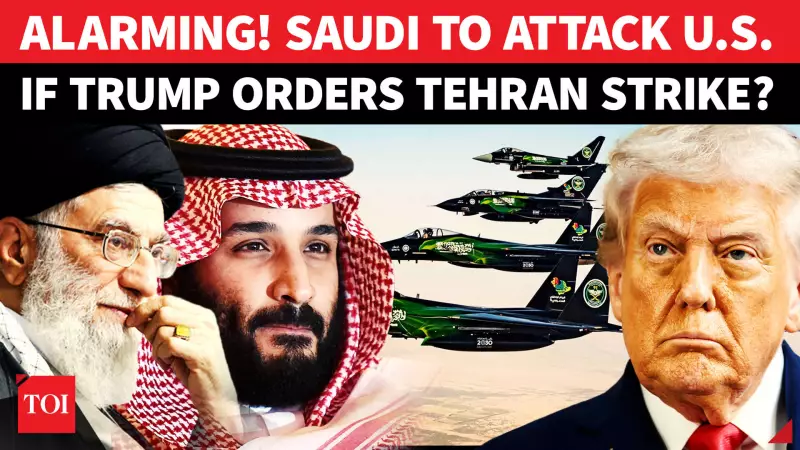
Saudi Arabia Announces Support for Iran in Confrontation with United States
In a dramatic geopolitical shift that is reshaping Middle Eastern alliances, Saudi Arabia has declared its backing for Iran in what it terms the "fight against the United States." Crown Prince Mohammed bin Salman (MBS) has publicly announced this support as former President Donald Trump reportedly plans military strikes against Tehran. This development signals a profound realignment in a region long characterized by frozen alliances and entrenched rivalries.
Historic Break from Traditional Rivalries
For decades, the geopolitical landscape of the Middle East remained relatively static, with Saudi Arabia and the United Arab Emirates (UAE) standing as steadfast allies of the United States. However, the ground is now shifting at an unprecedented pace. Both nations are visibly tilting toward Iran, even as Trump renews threats against the Islamic Republic. Crucially, Riyadh and Abu Dhabi have made it clear that they will not permit their airspace or soil to be used for any war against Tehran.
Riyadh's blunt and unequivocal rejection of aggression, coupled with the initiation of direct diplomatic talks with Iran, represents a stunning break from historical animosities. This move exposes a region that is increasingly choosing the path of de-escalation over escalation, actively rewriting the long-established rules of engagement and alliance. Washington now watches in real time as its traditional influence in the Middle East faces a significant and direct test.

Broader Context of Regional Realignment
This Saudi-Iranian rapprochement occurs against a backdrop of heightened global tensions. The announcement from Crown Prince Mohammed bin Salman underscores a strategic pivot that could redefine power dynamics across the Gulf and beyond. The UAE's simultaneous snub to Trump, by ruling out the use of its airspace for potential US operations, further solidifies this new axis of cooperation aimed at regional stability.
Other global powers are reacting to these shifts. Russian President Vladimir Putin has issued stark warnings regarding the consequences of a US attack on Iran, suggesting it could ignite a wider Middle Eastern conflict. Meanwhile, the ongoing situation in Ukraine and other international flashpoints continue to influence this complex diplomatic chessboard.
Implications for US Foreign Policy
The support announced by Saudi Arabia for Iran presents a direct challenge to United States foreign policy objectives in the region. For years, Washington has relied on Riyadh as a key counterbalance to Iranian influence. This new alignment forces a reevaluation of that strategy and highlights the diminishing returns of a purely confrontational approach toward Tehran.
As the Middle East chooses dialogue over conflict, the United States finds its traditional levers of power and influence being tested like never before. The coming months will be critical in determining whether this Saudi-Iranian entente holds and what it means for the future of American engagement in one of the world's most volatile regions.