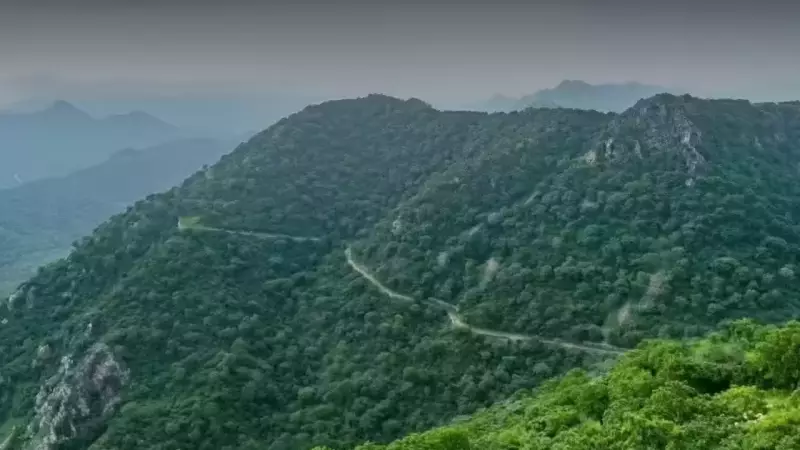
The Supreme Court of India has stepped into a critical environmental debate, admitting a petition that challenges a potentially game-changing definition of the Aravalli hills. The plea, filed by a retired Haryana forest official, contests a Union Environment Ministry committee's recommendation to identify only those Aravalli hills with an elevation of 100 metres or more for the purpose of regulating mining activities.
The Core of the Controversy
This recommendation gained significant legal weight on November 20, when the Supreme Court itself adopted it as a uniform definition to be applied to hills in the context of mining. The petitioner, R P Balwan, a former conservator of forest for south Haryana, argues that applying this 100-metre marker to the ancient Aravalli range would be a disaster for conservation. He warns it will undermine efforts to protect this crucial ecological barrier that runs from Gujarat to Delhi, shielding the northern plains from the Thar desert.
In a consequential order dated December 17, the Supreme Court sought formal responses from the Centre, the Haryana and Rajasthan state governments, and the Ministry of Environment, Forest and Climate Change (MoEFCC) on Balwan's plea. The application was filed within the landmark TN Godavarman Thirumulpad vs Union of India case, a 1996 litigation that famously led the court to expand the definition of forests beyond legally recognised ones.

Far-Reaching Ecological Consequences
Balwan told sources that the MoEFCC panel's stance could have severe and lasting ecological impacts. "By not recognising hills below 100 metres as part of the Aravallis, large parts of the range risk being pushed outside legal protection," he stated. He emphasized that this is not merely a technicality but a decision that will "directly affect the environmental future of Rajasthan, Haryana, Delhi and the entire north-western region of India."
He further pointed out inconsistencies in the ministry's own affidavit submitted to the court. "For example, the Forest Survey of India's more scientific definition based on a 3-degree slope was not accepted. Instead, a height marker of 100m was proposed, which the affidavit itself admits is inadequate," Balwan added.
Data Reveals a Stark Picture
Citing compelling data from the Forest Survey of India, Balwan highlighted a critical statistic: of the 12,081 hills mapped across India, only 1,048 (roughly 9%) are above 100 metres in height. He argues that mechanically applying this 100-metre threshold would, therefore, open up vast tracts of the topographically diverse Aravalli region to destructive mining and construction activities, stripping them of the protection they currently enjoy.
The Supreme Court has a history of intervening to protect the Aravallis. It has previously imposed strict curbs on mining in the ranges within Gurgaon, Faridabad, and Nuh, acknowledging that the environmental damage from unregulated extraction is irreversible.
Defending its 100-metre definition, the MoEFCC affidavit stated that its committee analyzed all definitions proposed by state governments concerning mining. It claimed a consensus was found on the criteria of an elevation of "100m and above from the local relief/ ground level, along with supporting slopes," a standard presently followed by Rajasthan for regulating mining in the Aravalli hills and ranges.
The court's upcoming decision will thus determine whether a purely numerical benchmark will override broader ecological considerations, setting a precedent for the conservation of one of India's oldest and most vulnerable mountain chains.