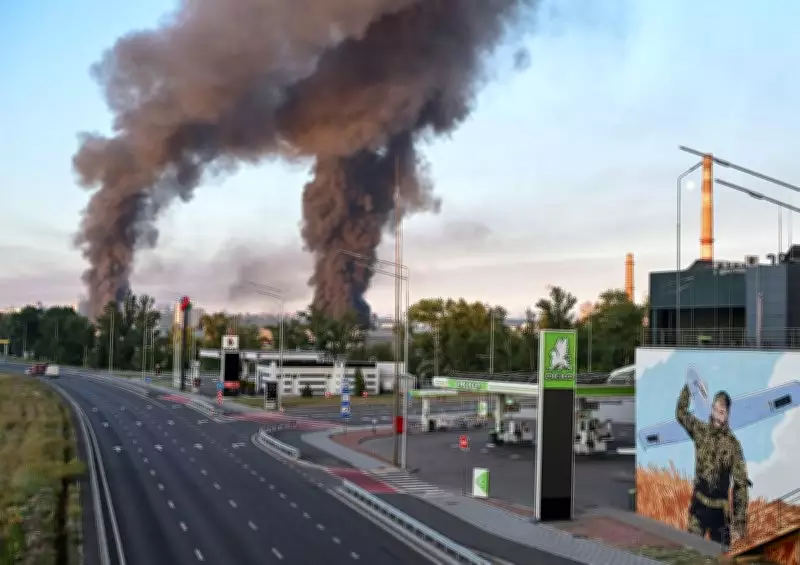
Russia launched hundreds of drones and dozens of missiles at Ukraine's capital Kyiv in the early hours of Thursday, killing at least 27 people, wounding 91, and damaging around 130 buildings in the deadliest attack on the capital this year, according to Ukrainian officials.
Massive Attack Details
Multiple explosions shook central Kyiv and reverberated across the capital throughout the night as thousands of residents rushed to bomb shelters and underground metro stations. Huge columns of smoke filled the skyline. The death toll climbed to 27 after an injured person died in hospital, with 91 injured, said Tymur Tkachenko, head of the capital's military administration, on Telegram.
Tkachenko warned the toll could rise as rescue teams worked through the night, sifting through rubble in search of trapped residents. At one site in an eastern suburb on the capital's left bank of the Dnipro River, teams recovered five bodies while eight residents were unaccounted for. "Rescue crews will work without interruption until all the debris is cleared. Unfortunately, more victims may still be found," he wrote.

Zelenskiy Blames Allies
President Volodymyr Zelenskiy, who cut short a visit to Ireland and rushed home, visited a site where a nine-storey residential building was half destroyed. He blamed the destruction partly on a failure of allies to deliver promised air defences. "If our partners had delivered on their promises in a timely manner, I think we could have saved more homes and lives today. All we ask of our partners is simply to do what we've agreed on. We're not even asking for more," said Zelenskiy, who looked tired and frustrated.
Later, in his nightly video address, Zelenskiy said the issue of air defences would be "one of the key outcomes" of next week's NATO summit in Turkey, repeating his call for European air defences. "If, of course, NATO still means anything to the allies. Europe must have its own sufficient capability to defend against all types of threats, including this one – from Russian ballistic missiles," he said.
Scale of Attack
Russia launched 74 missiles and 496 drones overnight, the Ukrainian air force said. Yuri Ihnat, the Air Force spokesperson, said the number of ballistic missiles was unusually high and the interception rate was low. Ukraine has struggled with shortages of Patriot missiles in recent months.
The Russian Defence Ministry said its "massive attack" using long-range, high-precision air-, land- and sea-launched weapons and drones hit military and energy facilities, as well as airports in Kyiv and other locations. Moscow said the attacks were retaliation for Ukrainian drone strikes on Russia. Kyiv, which has stepped up strikes on Russian domestic fuel supply, said it hit an oil refinery overnight in the Nizhny Novgorod region, where the governor reported one person killed.
Day of Mourning and Damage
Kyiv Mayor Vitali Klitschko announced a day of mourning for Friday. Damage was recorded across the city of about 3 million, with some buildings heavily damaged. The Ukrainian Red Cross said its humanitarian warehouse in Kyiv was destroyed, losing 320,000 relief items, "affecting emergency response and humanitarian operations across Ukraine."
Katarina Mathernova, the EU ambassador to Ukraine, said "Russia unleashed hell on Kyiv" overnight, striking accommodation used by diplomatic personnel. Diplomats were unharmed, but their belongings were damaged in a fire. City officials said the injured included children, paramedics, and drivers at an ambulance station.
"Our house is on fire. Oleg was pulling our neighbour out of the burning house, while I was phoning all the emergency services during the explosions. We do not have an apartment anymore," Kyiv resident Iryna Plekhova said on Facebook, posting a picture of a half-destroyed apartment building. The National Institute of Biochemistry was among damaged buildings: its state-of-the-art biochemistry laboratory and other offices were gutted. "This is a catastrophe for medical and biological science of Ukraine," biologist Yurii Danylovych told Reuters.

International Response
Poland, a NATO and EU member, briefly scrambled fighter jets as a preventive measure. Finland also briefly issued a temporary aviation restriction zone in the eastern Gulf of Finland. Kaja Kallas, the EU's foreign policy chief, said only sustained military support for Ukraine and increased pressure on Moscow could help stop Russian attacks. "Today, I will propose to sanction more entities supporting Russia's military-industrial complex in response to the strikes. The more Moscow attacks civilians, the more sanctions must be imposed," she said in a post on X.
U.N. Secretary-General Antonio Guterres condemned the attacks, describing them as part of a "deadly pattern" of strikes on populated areas. Zelenskiy has proposed peace talks with Putin, which the Kremlin leader has rejected. Zelenskiy said Ukrainian and US negotiators held talks in the past two days, and he hoped to meet U.S. President Donald Trump on the sidelines of the NATO summit.