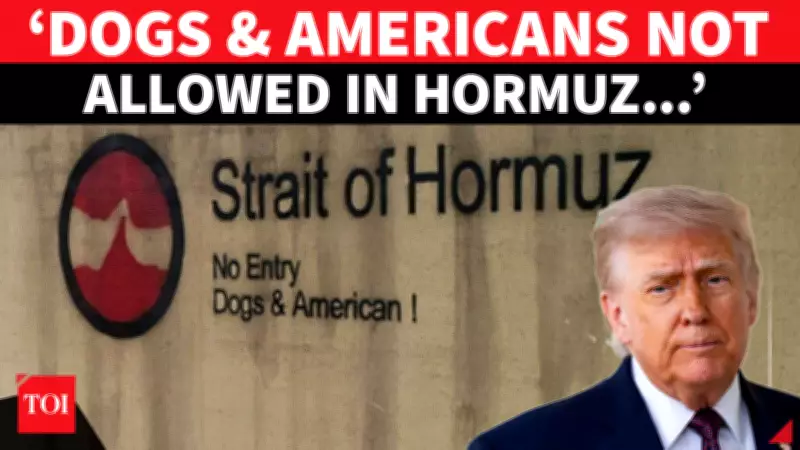
Provocative anti-American graffiti has appeared on walls across Tehran, declaring that 'Americans and dogs are banned from entering the Strait of Hormuz.' The slogan, now spreading rapidly on social media, comes amid soaring tensions between Iran and the United States in the Persian Gulf.
The graffiti references the strategically vital Strait of Hormuz, one of the world's most critical oil transit routes, as regional tensions continue escalating over naval deployments, tanker confrontations, and military threats. The phrase 'Dogs & Americans Banned' has been spray-painted in multiple locations, accompanied by images of the strait and Iranian flags.
This development follows a series of confrontations between Iranian fast boats and US warships in the Persian Gulf. New footage has emerged showing Iranian fast boats 'swarming' a US warship, while Iran has threatened a 'heavy assault' on US bases, with drones and missiles reportedly locked onto targets. The situation has drawn international concern, as any disruption to shipping through the Strait of Hormuz could impact global oil supplies.

Escalating Tensions in the Persian Gulf
The graffiti campaign reflects the deepening crisis between Tehran and Washington. Iran has repeatedly warned that it could block the strait in response to aggression, a move that would have severe economic repercussions. Meanwhile, the US has reinforced its naval presence in the region, leading to a standoff that experts fear could spiral into open conflict.
Social media users have shared images of the graffiti, with some expressing support for the anti-American sentiment and others condemning it as inflammatory. The Iranian government has not officially commented on the graffiti, but it aligns with the regime's hardline rhetoric against the United States.
Regional and Global Implications
The Strait of Hormuz is a chokepoint for approximately 20% of the world's oil supply, making any threat to its security a matter of global concern. Analysts warn that the current trajectory of tit-for-tat actions could lead to a miscalculation with catastrophic consequences. The graffiti, while symbolic, underscores the intense animosity that characterizes the current Iran-US relationship.
In related developments, Hezbollah has launched waves of 'precision attacks' on IDF positions in South Lebanon, and a huge fire has erupted near France's biggest airport. These incidents add to a backdrop of heightened geopolitical instability.