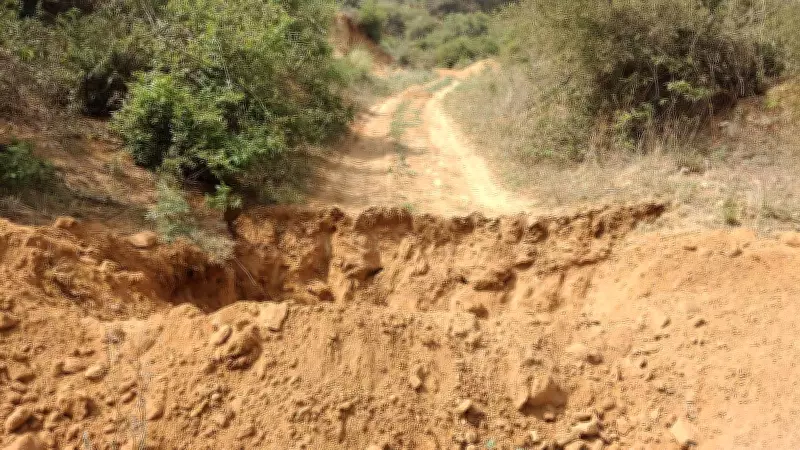
The Haryana forest department on Thursday blocked a dirt track used for transporting illegally mined sand and soil through the Raisina Aravalis. In response to reports of unauthorized mining activity in the area, authorities dug a trench across the route to prevent the movement of vehicles into the ecologically sensitive hills near Sohna. The excavated trench cuts across the pathway, effectively stopping tractors, trolleys, and other vehicles from accessing the forest.
Officials Take Action Against Illegal Extraction
Divisional forest officer Surender Dangi told TOI, “The route was being used for unauthorized movement of vehicles into the forest area. To prevent any further illegal extraction of sand and soil and to restrict vehicular access, we blocked the track. We are keeping the area under surveillance and will take strict action against anyone found violating forest and mining regulations.”
According to forest officials, tracks such as the one blocked in Raisina are often used to ferry illegally extracted material from remote parts of the Aravalis. By cutting off access routes, authorities hope to disrupt transportation networks that facilitate illegal mining operations.

Environmental Concerns
Environmentalists have long warned that excavation and the movement of heavy vehicles through the fragile hill ecosystem accelerate erosion, damage vegetation, and fragment wildlife habitat. The Raisina belt has remained under scrutiny for repeated allegations of illegal mining, encroachments, and unauthorized construction.
Officials said surveillance of vulnerable stretches of the Aravalis would continue, and additional access points could be blocked if required. The area will remain under monitoring to ensure the route is not reopened and that mining activity does not resume.
Background of Illegal Mining in Aravalis
The move comes against the backdrop of repeated instances of illegal mining in the Aravalis despite a series of Supreme Court orders aimed at protecting the ecologically fragile hill range. In May last year, the apex court criticized the Haryana government and its chief secretary for being in a “deep slumber” while a mining mafia allegedly decimated an Aravali hillock in Nuh district to extract around 80 lakh tonnes of minerals. The material was transported through a 45-metre-wide road illegally carved through protected Aravali forest land. Investigations also found that miners developed a network of roads through Basai Meo village, creating a transit corridor between mining lease areas in Rajasthan and south Haryana.
The Supreme Court first imposed a ban on mining within a 5-km radius of Delhi in 2002 after taking note of the environmental damage being caused to the Aravalis. In 2004, the ban was extended to mining operations in Faridabad. Subsequently, after assessing the extent of ecological degradation in Haryana, the court ordered the discontinuation of mining activities across the state in the Aravali region.
Decades of Degradation
Concerns over the impact of mining on the ancient mountain range have persisted for decades. In a 2018 report, the SC-appointed Central Empowered Committee (CEC) noted that nearly 25% of the Aravali range in Rajasthan had been lost to illegal mining. The committee warned that continued degradation of the hills posed serious threats to groundwater recharge, biodiversity, and ecological stability across the NCR region.
The Raisina Aravalis form part of a key ecological corridor linking forest patches across Gurgaon and Nuh. Conservationists say preventing vehicular access to sensitive forest areas is critical to safeguarding one of the NCR’s most important natural barriers against desertification and groundwater depletion.