Albert Einstein proved that time is relative and can be bent by gravity or extreme speeds. Similarly, truth is often bent by numerous variables—not material truth, but the larger Hegelian picture that filters to the world, as Jug Suraiya once called the 'real nature of the perceived universe'. This truth competes with the old maxim that a lie travels halfway across the world before truth puts on its shoes.
A popular social media quote is held as journalism's first commandment: 'If someone says it's raining and another says it's dry, your job is not to quote both but to look out the window and find which is true.' Like most viral memes, it is reductive. Whether it's raining, how one reports it, and why depends on availability heuristic, political leanings, scientific understanding, and theological beliefs.
Unfortunately, the decision about what news gets oxygen often focuses on variables, as seen in two deaths involving police on separate sides of the Atlantic.

'I Can't Breathe'
On May 25, 2020, George Floyd, a 46-year-old black man, was killed in Minneapolis when a police officer knelt on his neck despite Floyd saying he 'couldn't breathe'. This sparked global Black Lives Matter protests, even prompting the Indian cricket team to take a knee. Floyd, a career criminal, was elevated alongside Martin Luther King Jr., Thurgood Marshall, and Barack Obama.
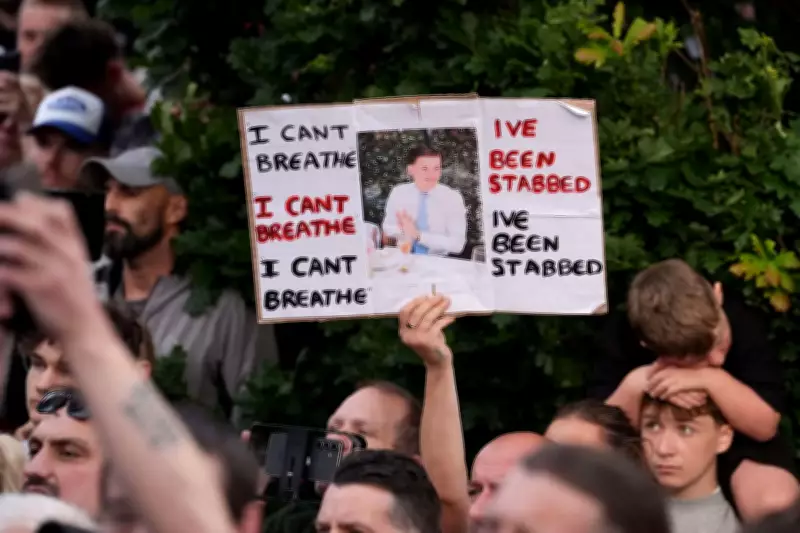
On December 3, 2025, in Southampton, Henry Nowak, an 18-year-old white man, was stabbed by Vickrum Singh Digwa, a Sikh man who claimed racial abuse. Police handcuffed Nowak as he lay dying, pleading he couldn't breathe and had been stabbed. An officer replied, 'Don't think you have, mate.' Court proceedings found Nowak's condition was critical after the first fatal stabbing, but handcuffing a bleeding victim was condemned.
The Nowak case received far less coverage in mainstream British media than Floyd's. When covered, it was framed as a cautionary tale, not a systemic issue. The cause was amplified on X by Elon Musk and his followers, becoming manna for Nigel Farage and Tommy Robinson, who used it to push their narrative about modern Britain.
Two-Tier Policing?
In the US, a longstanding complaint is that police disproportionately target black men. In the UK, the Right claims 'two-tier policing'—where minorities are treated more cautiously, racism allegations are prioritised, and right-wing protests are handled more harshly.
The concept originates from the 1999 Macpherson Report, which concluded British policing suffered from 'institutional racism' after the murder of Stephen Lawrence. The report defined a racist incident as 'any incident perceived to be racist by the victim or any other person'. Critics argue this hardened into an institutional reflex where perception of racism acquired immediate official force.
Tommy Robinson and his ilk argue this led to police handcuffing Nowak instead of his accuser. Nigel Farage called for 'pure cold rage', claiming 'rights and privileges of white people matter less than those of ethnic minorities'.
UK Prime Minister Keir Starmer rejected two-tier policing, saying there are 'serious questions' but no such thing. He slammed Farage for politicising Nowak's death and Elon Musk for 'whipping up division'.
Conservative author Peter Hitchens dismissed the 'two-tier' label in the Daily Mail, arguing this is part of a 'slow-motion British revolution' where police behave like paramilitary social workers serving a liberal elite. He wrote: 'The tricky catch-all term (institutional racism) was invented in 1967 by the American black power activist Stokely Carmichael, a nasty anti-Semite who called Hitler a genius. Should the sweeping reinvention of Britain's police be based on a charge invented by such a person? It led inexorably to the lonely death and insulting handcuffing of Henry Nowak.'
The Media Coverage
Floyd's killing was proof of systemic corruption and police brutality against black people, with 'Defund the Police' becoming a national slogan. Academics described the attention around Floyd as unprecedented; his name became one of the ten most frequently used phrases on Twitter in a single day.

The media broke the 'tricycle rule'. The phrase 'I can't breathe' became an approved slogan, taking the knee an approved ritual. Premier League, international cricketers, corporate brands, universities, and streaming platforms all joined. Floyd's death became a global template for institutional moral reckoning.
Nowak's case travelled a different pipeline. Mainstream media did not absorb it as a national moral reckoning. Instead, it focused on those speaking up, as if Farage's criticism was more newsworthy than Nowak's death or its circumstances.
British Right's BLM?
In some ways, Nowak's death is the British Right's George Floyd moment. Not because the cases are similar—Floyd died directly from police brutality, while Digwa killed Nowak, but the police scandal lies in the false racism allegation, handcuffing a dying victim, and failure to recognise a bleeding teenager. However, just as Floyd became a totem for the liberal movement, Nowak is fast becoming one for MAGA and the British far Right.
Anger across Britain is palpable, more so against a Prime Minister who appears hapless against every challenge: the American president, Labour peers, Nigel Farage, Tommy Robinson, Elon Musk, and even Larry the Cat.
Years ago, Christopher Hitchens gave an epistemological dictum known as Hitchens's Razor: 'What can be asserted without evidence can also be dismissed without evidence.' Thanks to how British authorities and the Fourth Estate reacted to Nowak's killing, it has become extremely hard to dismiss assertions by Musk, Robinson, and Farage without evidence, particularly that Britain is not safe for white people.
Hitchens's Razor cuts both ways. It works only when the assertion floats in the air like a pub bore's monologue. The problem for Starmer, the police, and the media is that the Nowak case gives the British Right something more potent than argument: a sequence of facts that appears to rhyme with its worldview.
That does not mean every claim by the British Right is true. Much is crude, opportunistic, and designed to turn grief into political fuel. But that is how movements are born—not from perfect evidence, but from images that feel like proof. George Floyd gave the progressive Left its most powerful visual indictment of American policing. Henry Nowak may give the British Right its own counter-myth: that modern Britain sees race before reality, fears the wrong accusation more than the obvious crime, and that some victims become inconvenient because the wrong people are angry on their behalf.
Which brings us back to the rain. The old journalism quote says the job is to look out the window and say whether it is raining. But in Minneapolis, the rain was declared a flood. In Southampton, the first instinct was to check who was holding the umbrella.
And that, perhaps, is why Henry Nowak may become the British Right's Black Lives Matter moment. Not because the two deaths are the same, but because both gave an ideological movement what it always waits for: a dead man whose final words seemed to prove everything it had already been saying.