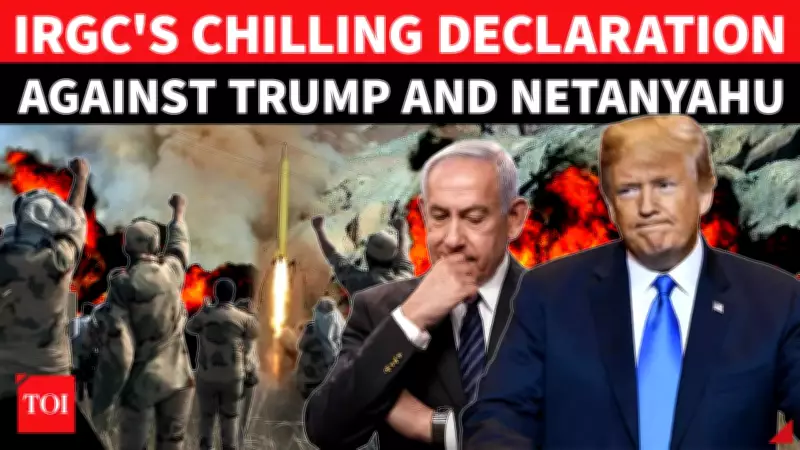
IRGC Declares 'Most Ferocious Offensive Operation' Against Israel and United States
In a dramatic escalation of regional hostilities, Iran's Islamic Revolutionary Guard Corps (IRGC) has publicly vowed to launch what it describes as the "most ferocious offensive operation" against Israel and United States military bases. This aggressive declaration comes as a direct response to the reported death of Iran's Supreme Leader, Ali Khamenei, which has ignited a firestorm of revenge rhetoric across the nation.
Revenge Rhetoric Soars as Tensions Explode
The Middle East is now bracing for a potentially devastating conflict, with tensions reaching unprecedented levels. The IRGC's statement, characterized by its intense and uncompromising language, signals a significant shift toward open military confrontation. Analysts warn that this development could trigger a chain reaction of violence, drawing multiple nations into a broader regional war.
According to sources, the IRGC's planned offensive is not limited to symbolic gestures but aims at inflicting substantial damage on both Israeli and American assets. The guard corps has explicitly mentioned targeting US bases located in strategic locations such as Qatar, Jordan, and Iraq, indicating a coordinated and wide-ranging assault strategy.

Regional Stability Hangs in the Balance
The reported death of Ali Khamenei has created a power vacuum and a national crisis in Iran, fueling the government's desire for retribution. In the wake of this event, Iranian officials have issued a series of ultimatums and threats, emphasizing that the coming punishment will be both "decisive" and "regret-inducing" for those perceived as responsible.
Meanwhile, Israel has remained on high alert, with Prime Minister Benjamin Netanyahu asserting Khamenei's death without providing concrete evidence, further complicating the already volatile situation. The United States, for its part, is closely monitoring the IRGC's movements and preparing for possible retaliatory strikes.
Potential Global Implications
The conflict's ripple effects extend beyond the immediate region, posing serious risks to global energy security and international trade. Iran has previously threatened to block the Strait of Hormuz, a critical chokepoint for oil shipments, which could disrupt world energy supplies and trigger economic instability.
Additionally, recent reports of drone attacks on Kuwait Airport and missile strikes in Abu Dhabi underscore the expanding geographic scope of the hostilities. Civilian casualties and infrastructure damage are mounting, raising humanitarian concerns and the specter of a prolonged, multi-front war.
As the situation continues to evolve, diplomatic efforts to de-escalate the crisis face immense challenges. The international community watches with apprehension, aware that any miscalculation or aggressive action could plunge the Middle East into an even deeper and more destructive conflict.