Israel and US Launch Joint Military Operation 'Epic Fury' Against Iran
The Middle East has plunged into a new phase of intense conflict as Israel and the United States executed a coordinated military operation against Iran on Saturday. Dubbed "Epic Fury," this joint offensive marks a significant escalation in regional tensions, with the initial strikes targeting locations near the offices of Supreme Leader Ayatollah Ali Khamenei in Tehran.
Political Justifications and Statements
In his first public remarks following the attacks, US President Donald Trump declared that the United States has commenced "major combat operations in Iran." He asserted that Iran has persistently advanced its nuclear program and is developing missiles with the potential to reach American soil. Trump made a direct appeal to the Iranian populace, urging them to "take over your government — it will be yours to take."
Israeli Prime Minister Benjamin Netanyahu echoed these sentiments, praising the collaborative effort between Israel and the United States. He characterized Iran's regime as a "murderous terrorist regime" that must be prevented from acquiring nuclear weapons. Netanyahu expressed gratitude to President Trump for his "historic leadership" in this endeavor, emphasizing that the operation aims to eliminate an existential threat posed by Iran.

Military Deployment and Strategic Planning
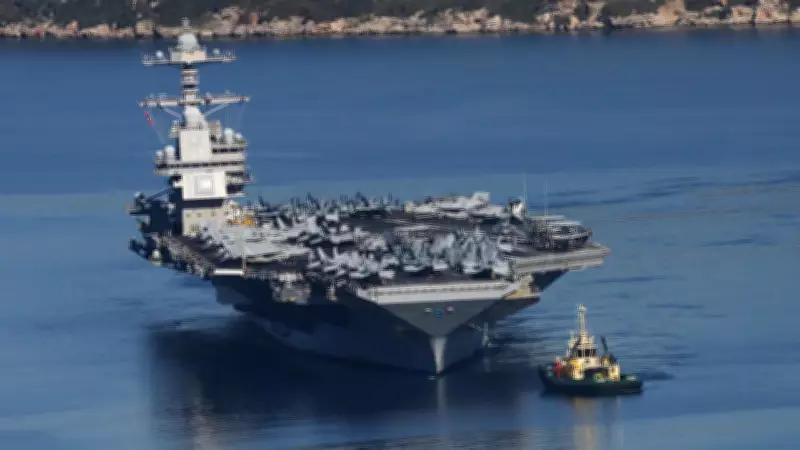
This development follows weeks of substantial US military buildup in the Middle East, involving the deployment of aircraft carriers, fighter jets, guided-missile destroyers, and other critical assets. Notably, two of the largest US warships, the Gerald R. Ford and the Abraham Lincoln, are part of this mobilization.
According to Reuters, the strikes are being conducted through both aerial and naval means. An Israeli defense official revealed that the operation had been meticulously planned over several months in coordination with Washington, with the launch date finalized weeks in advance. Sources cited by The Times of Israel indicate that the "initial phase" of the joint attack is scheduled to last at least four days.
Geopolitical and Economic Implications
Iran's strategic location on the northern shore of the Strait of Hormuz, a vital corridor for global oil and liquefied natural gas shipments, positions it as a key player in international energy security. Additionally, Iran borders the Caspian Sea, the world's largest inland body of water, which it shares with Russia and several Central Asian nations.
Amid ongoing tensions with Washington, the United States has effectively encircled Iran from over 30 military bases and deployed significant naval resources across the region.
Detailed US Military Assets in the Region
Air Assets:
- At Crete, Greece: RC-135V reconnaissance aircraft.
- At Azraq, Jordan: F-15 Eagle multirole fighters, E/A-18G Growler electronic warfare aircraft, and A-10 Warthog attack aircraft.
- At Al Kharj, Saudi Arabia: E-11A BACN battlefield communication aircraft, F-16 Fighting Falcon multirole fighters, P-8A Poseidon reconnaissance aircraft, and E-3 early warning and command aircraft.
- At Awali, Bahrain: P-8A Poseidon reconnaissance aircraft.
- At Al Dhafrah, UAE: MQ-4C Triton high-altitude, long-endurance unmanned aircraft.
Naval Assets:

- In the Red Sea: USS Delbert D. Black, a guided-missile destroyer.
- In the Persian Gulf: USS Tulsa and USS Canberra, both littoral combat ships.
- In the Northern Arabian Sea: The Lincoln Carrier Strike Group, led by the aircraft carrier USS Abraham Lincoln, accompanied by destroyers USS Frank E Petersen Jr, USS Spruance, USS McFaul, and USS Pinckney. The air wing includes F/A-18E Super Hornet multirole fighters, EA-18G Growler electronic warfare aircraft, E-2 Hawkeye early warning and control aircraft, MH-60S and MH-60R Sea Hawk helicopters, and F-35C Lightning II fighter jets.
- In the Strait of Hormuz: Destroyer USS Mitscher, littoral combat ship USS Santa Barbara, and destroyer USS Michael Murphy.
- The advanced Ford Carrier Strike Group, led by the aircraft carrier USS Gerald R Ford, has been repositioned from near Greece to waters closer to Israel. It includes destroyers USS Bainbridge, USS Mahan, and USS Winston S Churchill, with an air component featuring F/A-18E Super Hornet multirole fighters, EA-18G Growler electronic warfare aircraft, E-2 Hawkeye early warning and control aircraft, MH-60S and MH-60R Sea Hawk helicopters, and C-2A Greyhound cargo aircraft.
The "Epic Fury" operation underscores a dramatic intensification of hostilities in the Middle East, with far-reaching consequences for regional stability and global security dynamics.