Ambush Highlights Internal NSCN-IM Revolt
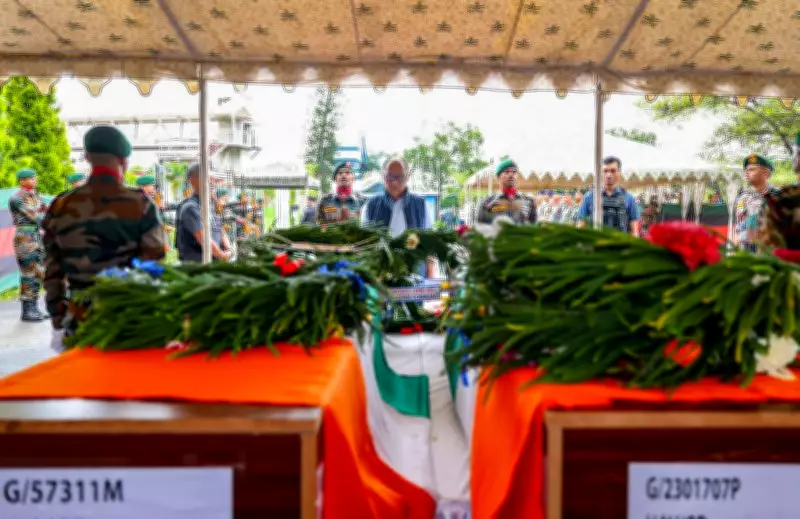
The July 6 ambush on an Assam Rifles convoy in Manipur's Ukhrul district killed Warrant Officer Balwant Singh and Havildar Chandra Mohan Singh, marking a watershed moment for North-East security. The attack is not a localized strike but the violent externalization of an ideological civil war within the National Socialist Council of Nagalim-Isak-Muivah (NSCN-IM), signaling volatile cross-border insurgent dynamics along the India-Myanmar frontier.
Tactical Execution of the Ambush
The strike near Nungshangkhong was executed with precise military coordination, using a high-yield IED to disrupt the convoy followed by coordinated automatic gunfire. The two-hour gunbattle with the Assam Rifles indicates tactical confidence and logistical depth unseen in Naga-dominated hills for years. The ambush capitalized on local friction after violent protests erupted over a temporary Assam Rifles outpost in Ukhrul's New Haven area, allowing perpetrators to leverage regional instability.
Eastern Flank's Revolt Against NSCN-IM Leadership
While NSCN-IM leadership at Hebron denied involvement, intelligence agencies point to the 'Eastern Flank' — the Myanmar-based wing led by Hanshi Ramsan and deputy Absalom Raman. In mid-June 2026, the faction issued a manifesto of 'Strong Disagreement,' revolting against Thuingaleng Muivah's leadership over alleged capitulation on demands for a separate Naga flag and constitution (Yezhabo), and accusations that senior leaders colluded with New Delhi to dismantle the movement's revolutionary character.

Escalation into Armed Conflict
The rift turned violent earlier in 2026 when four Eastern Flank cadres were killed by mainstream NSCN-IM forces in Kamjong district, sparking mob violence in Ukhrul. On June 24, the formal expulsion of Ramsan and Raman on treason charges turned the Eastern Flank into a rogue faction unconstrained by the 1997 Ceasefire Ground Rules.
Strategic Threat from Myanmar Border
Operating from the Somra Tract in western Myanmar, Ramsan's cadres exploit the porous border. Recent Myanmar military offensives have squeezed these sanctuaries. Pushed out of bases and stripped of official ranks, the breakaway faction likely viewed a spectacular strike as a tactical necessity to re-establish relevance, sabotage peace talks, and provoke a heavy-handed security response that could alienate locals and drive recruits to radicalism.
Operational Challenges for Indian Security Forces
The ambush ends the status quo of a predictable ceasefire maintained for nearly three decades. Indian forces now face a multi-front campaign: managing ethnic blockades in Manipur and the Naga-Meitei-Kuki imbroglio while conducting counter-insurgency against a mobile guerrilla force able to slip across the Myanmar border. A single misstep could inflame the unstable tribal landscape.
The attack represents a dangerous intersection of internal factional collapse and cross-border insurgency. By attacking the Assam Rifles, Ramsan's Eastern Flank has declared war on both New Delhi and the moderate approach of its parent organization. As security forces intensify manhunts in rugged Naga areas, the incident underscores that unresolved core political questions of the Naga movement leave peace fragile, vulnerable to radical commanders and the shadows of the Myanmar border. New Delhi must wake up to this stark reality.