

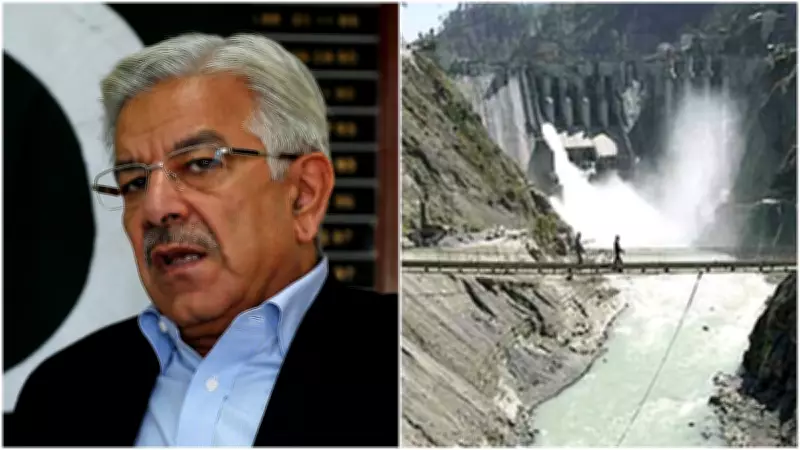
Pakistan's Defence Minister Khawaja Asif has threatened military action against India, stating that his country would go to war if India attempts to alter the Indus Waters Treaty. The statement, made during a parliamentary session, represents a significant escalation in rhetoric over water-sharing rights in the region.
Threat of War Over Water Rights
In a session of the Pakistani Senate, Asif declared, "If India tries to change the Indus Waters Treaty, we will go to war against India." He emphasized that Pakistan considers any modification to the treaty as a violation of its sovereignty and a threat to its national security. The minister's comments come amid ongoing tensions between the two nuclear-armed neighbors, who have fought multiple wars since partition in 1947.
The Indus Waters Treaty, brokered by the World Bank in 1960, allocates the waters of the Indus River system between India and Pakistan. Under the treaty, India controls the eastern rivers (Ravi, Beas, Sutlej), while Pakistan controls the western rivers (Indus, Chenab, Jhelum). India is permitted limited use of the western rivers for non-consumptive purposes like hydroelectric power generation.

Recent Disputes and India's Stance
Tensions have risen in recent years as India has pursued hydroelectric projects on the western rivers, which Pakistan claims violate the treaty. In 2016, after a militant attack on an Indian army base in Uri, India's Prime Minister Narendra Modi suggested that "blood and water cannot flow together," hinting at a potential review of the treaty. However, no formal steps have been taken to revoke or renegotiate the agreement.
India maintains that its projects comply with the treaty's provisions and that it has not violated any clauses. The Indian government has not officially responded to Asif's latest threat. Historians note that the treaty has survived three wars between the two countries and is considered a rare example of successful water-sharing diplomacy.
International Implications
The World Bank, which facilitated the treaty, has previously expressed its commitment to the agreement. Any unilateral alteration or abrogation could have severe consequences for regional stability. Water experts warn that climate change and population growth are increasing pressure on water resources in South Asia, making cooperation essential.
Asif's comments have drawn criticism from some Pakistani politicians who argue that threatening war is counterproductive. Opposition Senator Sherry Rehman called for de-escalation, stating, "We need diplomacy, not threats of war." The incident underscores the fragility of Indo-Pak relations and the potential for water disputes to trigger broader conflict.






