

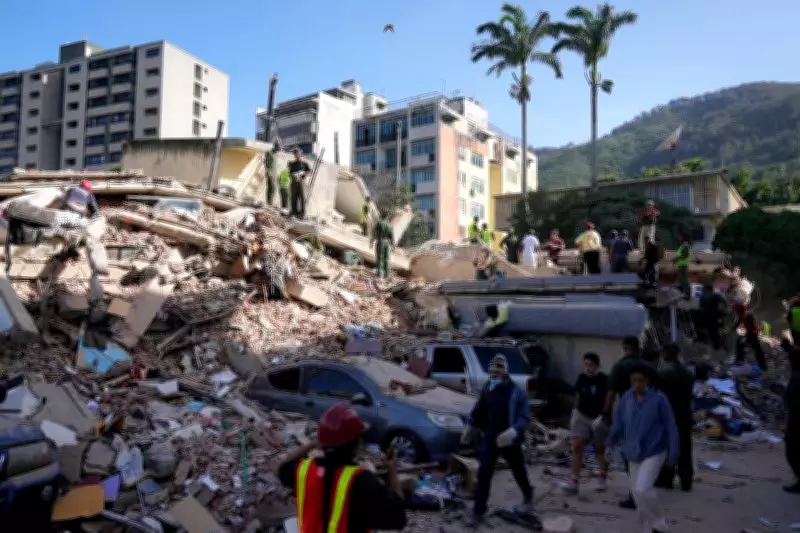
Rescue teams in Venezuela are racing against time as the window for finding survivors narrows following last week's devastating twin earthquakes that have left more than 1,700 people dead and thousands homeless. Five days after the disaster, the focus is shifting to the country's worsening humanitarian crisis, which could persist for years.
Death Toll and Aftershocks
The Venezuelan government confirmed that the death toll has surpassed 1,700, though experts believe the actual number could be significantly higher. A 4.6 magnitude aftershock struck the northern state of La Guaira on Monday, according to the United States Geological Survey, sending residents in Caracas screaming into the streets. Jorge Rodriguez, leader of the Venezuelan National Assembly, said there were no reports of damage from the latest tremor, but the psychological toll remains high.
Government Response Under Scrutiny
Facing criticism for a slow and inadequate response, government officials have aggressively promoted their recovery efforts. Police and military personnel distributed canned food to displaced people in La Guaira. Rodriguez stated that electricity had been restored to 90% of the hardest-hit state and that 15 temporary displacement camps had been set up. However, many Venezuelan news reports have avoided politically sensitive questions about building collapses, focusing instead on heroic rescues.

Acting President Delcy Rodriguez shared footage of emergency workers rescuing a man after 43 hours, writing on X: "Each life saved is a victory for hope." But for many families, hope is fading. Ana Rada, watching civil defense workers search for her brother, said: "We have to stay strong, even without food, without sleep. Until I see the body, I still have hope."
International Aid and US Involvement
Dozens of countries have offered assistance, with the United States playing a major role. A senior State Department official said 300 US first responders are on the ground, and two dozen C-17 military transport planes arrive daily with supplies. US financial support now exceeds $300 million. The US military is also helping repair the port in La Guaira and manage air traffic after the quake damaged the control tower at Simon Bolivar International Airport.
However, the Trump administration is unlikely to grant temporary humanitarian protections to Venezuelans already in the US, as was done after earthquakes in Haiti and El Salvador. More than 100 Venezuelans recently deported from the US were staying at a hotel in Venezuela when the quake hit, and many are now missing.
Rescuer's Story: A Deportee's Odyssey
Among the rescuers is Jean Sosa, a 31-year-old miner deported from the US in January over a missed immigration court hearing. He had built a new life in New York City, working at a taco stand near Penn Station, before being detained and shuttled across detention centers. He was eventually left in southern Mexico without his passport, phone, or wallet. Since arriving in La Guaira, he has used his old mining pickaxe to pull people from the rubble. "Many people could have been saved if there had been equipment and support from top authorities from the very beginning," he told the Associated Press. "We're working without gloves, without equipment, borrowing supplies, improvising bandages."
Scale of Damage Disputed
The full scale of destruction remains unclear. While the government reports 855 damaged or collapsed buildings, a preliminary NASA assessment using radar imagery from European Space Agency satellites puts the number at 58,870 buildings. The United Nations estimates that up to 6.8 million of Venezuela's nearly 30 million residents may be affected. The Venezuelan Red Cross expects to address the needs of at least 300,000 people for the next two years.
Government figures are released in brief televised announcements without opportunity for questions. The Venezuelan press union reported that the Ministry of Communication is blocking foreign reporters' access to La Guaira for 48 hours, citing the need to "reduce noise during rescue operations." The union urged the government to drop the restriction, stating: "As hours pass, the health situation may worsen, and the country needs verified and timely information."

Missing Persons and Digital Databases
Due to chaos and poor phone service, many Venezuelans are turning to non-governmental digital databases to report missing loved ones. More than 50,000 people have been reported missing on one such database, though it is unclear how many have been found. Firefighter Kleider Carrillo said nothing prepared him for the destruction: "When you study for this profession, you're trained for situations like this. But what's in textbooks is one thing. Reality is another."





