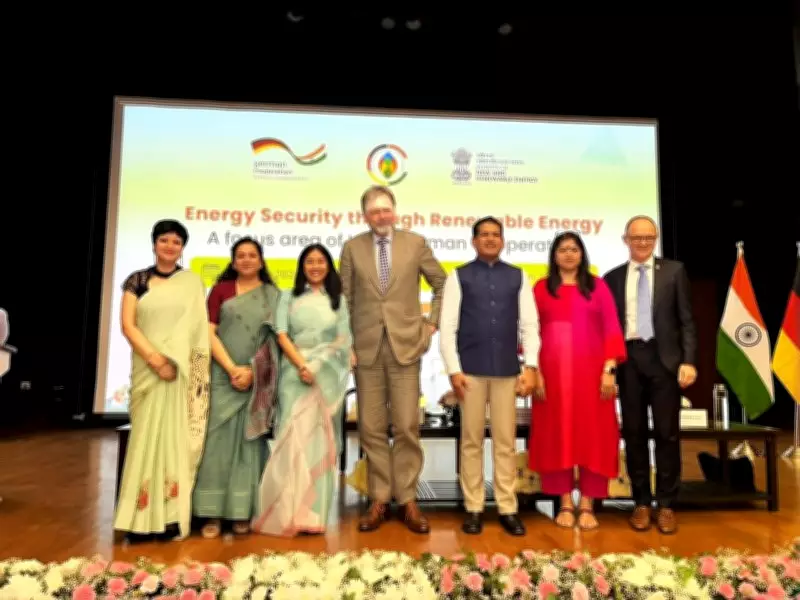
The Indo-German Partnership for Green and Sustainable Development (GSDP) held the tenth edition of its Conversation Series in New Delhi, in collaboration with the Ministry of New & Renewable Energy (MNRE). The event focused on the theme 'Energy Security through Renewable Energies'. The high-level panel included senior representatives from MNRE, industry leaders, think tanks, private sector players, and renewable energy experts. Discussions centered on accelerating India's renewable energy transition and using renewables to strengthen the economy against fossil fuel price shocks.
Key Speeches and Remarks
German Ambassador to India, Dr. Philipp Ackermann, stated in his opening address that renewable energy is not just a climate imperative but also an economic and strategic necessity. He highlighted that India and Germany share the challenge of reducing dependence on imported fossil fuels and increasing energy independence. He noted that renewables create a 'trinity' of climate action, economic opportunity, and energy security. India has made significant progress, with renewable sources contributing around 26% of electricity generation.
The GSDP partnership is particularly significant as India and Germany mark 75 years of diplomatic relations. The longstanding bilateral development cooperation has evolved into a partnership addressing climate action and sustainable development for resilient economic growth. Both countries are working closely on renewable energy deployment and manufacturing, battery storage, grid integration, energy efficiency, transition of hard-to-abate sectors, green urban mobility, biodiversity, climate change mitigation and adaptation, sustainable urban development, and vocational education.

India's Renewable Energy Priorities
Santosh Kumar Sarangi, Secretary of MNRE, presented India's renewable energy priorities. He emphasized the relevance of energy security and expectations from international cooperation. He noted that the recent crisis in West Asia has highlighted the critical importance of energy security. Renewable energy, including solar, wind, battery energy storage systems, and green hydrogen, has immense potential to strengthen energy security while supporting sustainable development. He mentioned that non-fossil fuel sources now account for approximately 54% of India's installed electricity capacity, and India remains committed to achieving 500 GW of non-fossil fuel capacity by 2030. He expressed confidence that India and Germany can continue to work together to drive innovation, mobilize investment, and advance shared goals of energy security, sustainable development, and climate action.
India has set an ambitious target of achieving 500 GW of non-fossil fuel capacity by 2030 and net zero emissions by 2070. Solar, wind, and energy storage are key technologies that will reduce dependence on fossil fuels and support India's transition to a low-carbon economy. India's rapid economic growth and rising energy needs have made energy security a critical pillar of national development. Ensuring reliable and affordable energy is essential for sustaining economic growth and achieving the vision of 'Viksit Bharat' and a USD 30 trillion GDP by 2047.
Panel Discussion Insights
During the discussion, speakers underscored the need to scale up renewable energy, invest in energy storage and grid modernization, and strengthen public-private collaboration to enhance energy security and support sustainable economic growth. Renewable energy is now seen as a core pillar for decarbonization in all sectors. The next phase of India's transition will require an integrated approach encompassing generation, transmission, distribution, storage, financing, domestic manufacturing, localized energy solutions, and electrification of energy-intensive sectors.
According to the NITI Aayog Pathway to Net Zero report published in February 2026, the real risk to Net Zero implementation is whether the system can absorb, transmit, finance, and reliably use cleaner power at scale.
The esteemed panelists included Philipp Ackermann, German Ambassador to India and Bhutan; Santosh Kumar Sarangi, Secretary, MNRE; Vaishali Nigam Sinha, Co-founder and Chairperson of Sustainability, ReNew; and Aparna Roy, Fellow and Lead, Climate Change and Energy, ORF New Delhi.

Long-Standing Partnership
Germany has been a long-standing partner in India's energy transition. Through Indo-German development cooperation, both countries have worked together on renewable energy expansion, power sector reform, power transmission and distribution, energy storage, green hydrogen, energy efficiency, climate finance, and skills development. The Indo-German Partnership for Green and Sustainable Development (GSDP), launched in 2022, is a strategic cooperation framework supporting sustainable and climate-aligned development. The partnership advances solutions that contribute to the Sustainable Development Goals and the goals of the Paris Agreement.