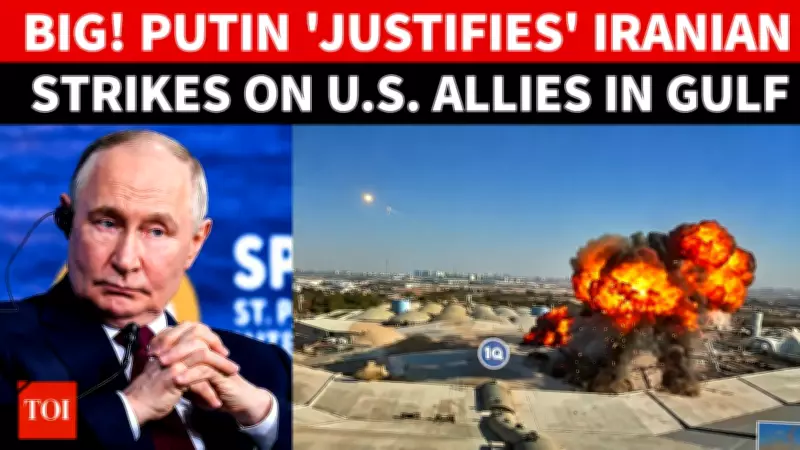
Russian President Vladimir Putin addressed the escalating tensions involving Iran during the 29th St. Petersburg International Economic Forum (SPIEF), revealing the difficult diplomatic position Moscow faces amid growing regional instability. Putin said Russia has consistently urged its Iranian partners to avoid strikes on neighboring countries. However, he noted that Iranian officials have defended their actions by pointing to attacks against their own territory and leadership, arguing that they were compelled to respond. The Russian leader acknowledged that the situation places Moscow in a challenging position, given Russia's close ties with Iran as well as its strong relationships with Arab nations across the Middle East. Putin's remarks offer a rare glimpse into the balancing act Russia is attempting to maintain as tensions continue to rise in the region.
Putin's Balancing Act
During his address at the forum, Putin elaborated on the complexities of Russia's foreign policy in the Middle East. He emphasized that Moscow has consistently called for de-escalation and urged all parties to exercise restraint. The Russian president highlighted the humanitarian impact of the conflict, noting that civilians, including children, are being killed on both sides. 'Their kids are killed,' Putin said, referring to the loss of innocent lives in the region. He stressed that Russia's primary concern is the safety of all people and the prevention of further escalation.
Iran's Justification
Putin revealed that Iranian officials have justified their strikes as retaliatory measures. According to the Russian leader, Tehran argues that attacks on its territory and the assassination of its leaders left it with no choice but to respond. Putin did not explicitly endorse or condemn Iran's stance but framed it as part of the broader cycle of violence that Moscow is trying to break.

Regional Implications
The Russian president's comments come at a time when Iran has intensified its military operations against Gulf states, including drone strikes on oil facilities and other infrastructure. These actions have raised concerns about a wider regional conflict that could disrupt global energy markets and further destabilize the Middle East. Russia, which maintains strong economic and military ties with Iran, also has strategic partnerships with Saudi Arabia, the United Arab Emirates, and other Gulf nations. This dual alignment forces Moscow to navigate carefully to avoid alienating any of its partners.
International Reactions
Putin's remarks have drawn attention from world capitals, with analysts noting that Russia's position is becoming increasingly untenable as the crisis deepens. Some Western officials have criticized Moscow for not doing more to rein in Iran, while others acknowledge the complexity of Russia's relationships in the region. The United States, which has its own strained ties with Iran, has called on all parties to de-escalate and has offered to mediate. However, Putin's statements suggest that Russia is seeking a more independent role, aiming to position itself as a mediator rather than taking sides.
Conclusion
As the situation in the Gulf continues to evolve, Russia's ability to maintain its balancing act will be tested. Putin's candid acknowledgment of the 'difficult situation' underscores the challenges Moscow faces in a region where its interests are diverse and sometimes conflicting. The coming weeks will likely see increased diplomatic efforts from Russia and other powers to prevent the conflict from spiraling out of control.