

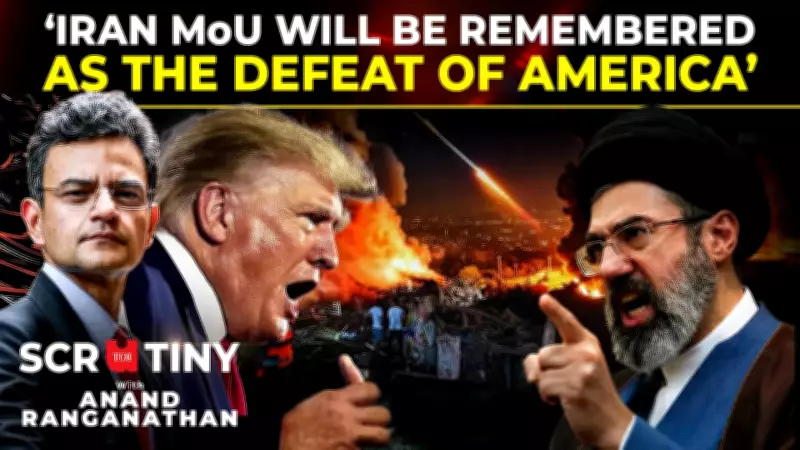
Political commentator Anand Ranganathan has delivered a scathing assessment of the recent Iran-U.S. memorandum of understanding, declaring that Iran emerged as the sole strategic victor from the military confrontation. In an explosive interview, Ranganathan described the agreement as a 'defeat of America' and compared its long-term implications to the Treaty of Versailles, which sowed the seeds of future conflict.
Ranganathan's Verdict: Iran the Only Winner
According to Ranganathan, the memorandum of understanding effectively ended the conflict but handed Tehran a decisive strategic victory. He argued that despite the U.S. military superiority, Iran gained leverage through the deal, while the United States lost strategic ground in the Middle East. 'Iran is the only winner here,' Ranganathan stated, emphasizing that the agreement represents a fundamental shift in regional power dynamics.
The commentator pointed out that the U.S. entered the confrontation with clear military objectives but failed to achieve them, ultimately settling for terms that favor Iranian interests. He likened the situation to the Treaty of Versailles after World War I, which imposed harsh conditions on Germany and is widely regarded as a contributing factor to World War II. 'This deal has the same potential to destabilize the region in the long run,' Ranganathan warned.

Strategic Implications for the Middle East
Ranganathan's analysis highlights several key outcomes of the agreement. He noted that Iran has secured economic relief and political recognition without making significant concessions on its nuclear program or regional activities. 'Tehran has effectively normalized its position as a major regional player,' he said, adding that the U.S. has acknowledged Iran's influence in countries like Iraq, Syria, and Yemen.
The commentator also criticized the U.S. administration for what he called a 'senseless war' that achieved no clear objectives. 'The American public was sold a narrative of decisive action, but what we got was a negotiated settlement that benefits Iran,' Ranganathan asserted. He argued that the U.S. lost credibility among its allies in the region, particularly Israel and Saudi Arabia, who now view American security guarantees as unreliable.
Comparison to the Treaty of Versailles
Drawing a historical parallel, Ranganathan argued that the Iran-U.S. memorandum of understanding could have similar destabilizing effects as the Treaty of Versailles. 'Versailles created a sense of humiliation and resentment that led to another world war,' he explained. 'This deal may not cause a global conflict, but it will certainly fuel regional tensions and embolden Iran's adversaries.'
He pointed out that the agreement leaves key issues unresolved, including Iran's ballistic missile program and its support for proxy groups. 'These are time bombs that will explode later,' Ranganathan said. 'The U.S. has kicked the can down the road, but the underlying problems remain.'
Impact on U.S. Strategic Position
Ranganathan's critique extends to the broader implications for American foreign policy. He argued that the U.S. has lost its deterrent capability in the Middle East by agreeing to terms that appear to reward Iranian aggression. 'Other actors in the region will now question whether the U.S. is willing to use force to defend its interests,' he said.
The commentator also noted that the deal could have repercussions for U.S. relations with Europe and Asia, as allies may see Washington as an unreliable partner. 'If the U.S. can't stand firm against Iran, how can it be trusted to defend NATO or counter China?' Ranganathan asked rhetorically.
Conclusion: A New Geopolitical Reality
In his explosive interview, Ranganathan concluded that the Iran-U.S. memorandum of understanding marks a turning point in Middle Eastern geopolitics. 'Iran has emerged stronger, the U.S. weaker, and the region more volatile,' he said. 'This is a defeat for America, and the consequences will be felt for years to come.'

The full interview, available on TOI.in, provides an in-depth analysis of one of the most consequential geopolitical developments of the year. Ranganathan's comments have sparked debate among analysts, with some agreeing that Iran gained leverage while others argue that the deal prevents a wider war. Regardless of perspective, the interview underscores the complexity of the Iran-U.S. relationship and its impact on global security.





