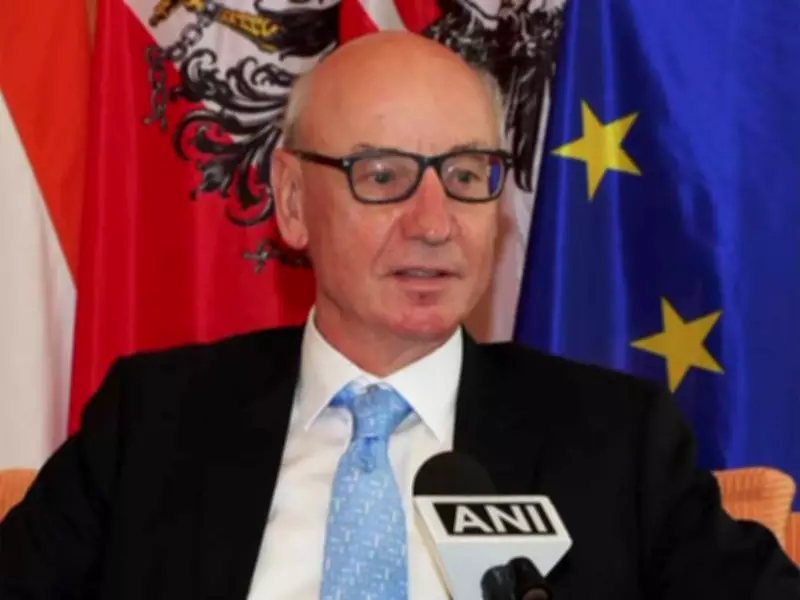
Austrian Ambassador to India Robert Zischg has described Russia's invasion of Ukraine as a defining challenge for Europe's future, stating that the conflict extends beyond Ukraine's sovereignty to the continent's long-term security architecture. In an interview with ANI, Zischg warned that any settlement must address broader concerns over regional stability.
Conflict at Europe's Doorstep
Zischg noted that the war, which completed four years in February 2025, is of fundamental interest to Austria and the European Union because it is unfolding at Europe's doorstep. "It's about the future security architecture of Europe," the ambassador said, emphasizing that the implications go well beyond Ukraine.
He cited drone attacks in Romania and other Baltic countries as evidence that even a settlement with Ukraine might not guarantee an end to Russian aggression. "Who would guarantee us that President Putin would not continue? The unthinkable nowadays has become thinkable," Zischg added.

Austria's Historical Perspective
Describing the conflict as "very tragic," Zischg highlighted Austria's historical experience under Soviet occupation from 1945 to 1955 and its position on the edge of the Iron Curtain. Neighbouring countries under communist rule endured authoritarian regimes and difficult conditions, he recalled.
"This is why the Russian aggression against Ukraine is of such a fundamental interest, not only to Austria but also to the European Union. It's at our doorstep," he said.
International Law and Sovereignty
The ambassador, who described himself as an international law expert, underscored the importance of the United Nations Charter in safeguarding the sovereignty and independence of all nations, particularly small and medium-sized states. "International law guarantees the independence and sovereignty of all countries," he said.
Zischg argued that the UN Charter fundamentally changed international relations after 1945 by placing restrictions on the use of force. "If you do away with that regulation, then we're at the mercy of the big powers, as it has been until 1945," he warned.
Distinct Nature of the Conflict
Zischg distinguished the Ukraine conflict from other global crises, noting that Russia's invasion involved one sovereign country attacking another with the aim of taking over its territory. "In Ukraine, it's actually very simple. One country, the Russian Federation, invaded another country, Ukraine, with the aim of taking over that country. And now, as they did not conquer the whole of the country, they want to take at least a large chunk of that country," he said.
He stressed that this situation stands out among other conflicts raging in the world, which are equally depressing and need urgent resolution. "I don't know of any other example where one country invaded another country to take over this country," he added.
Consequences for European Security
Zischg said the outcome of the conflict would have lasting consequences not only for Ukraine but also for Europe's security order in the years ahead. The Ukraine-Russia conflict, which began with Russia's full-scale invasion in February 2022, remains one of Europe's biggest security challenges. Despite diplomatic efforts and discussions on a possible ceasefire, the war has shown little sign of lasting resolution, with fighting continuing across multiple fronts.