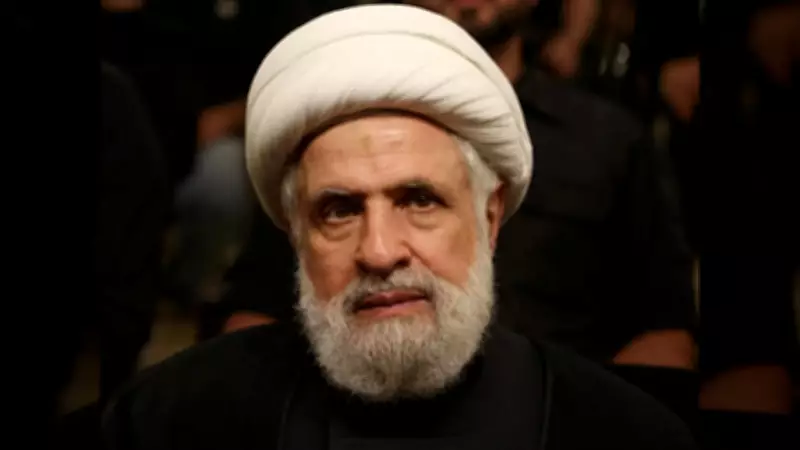
BEIRUT: Hezbollah leader Naim Qassem has declared that the group's military capabilities are strictly a domestic Lebanese concern and will not be placed on the bargaining table during ongoing hostilities with Israel.
According to a report by Al Jazeera, the Hezbollah chief took a defiant stance against Israeli military pressure, vowing that his fighters remain prepared for a prolonged confrontation. "We will not abandon the field. We will turn it into hell for Israel," Qassem asserted during a televised address.
Framework for Cooperation with Lebanese Government
The group's leader outlined a framework for future cooperation with the Lebanese government, focusing on five pivotal objectives. These goals include securing Lebanese sovereignty by ending Israeli aggression, ensuring the total withdrawal of Israeli forces from occupied lands, the liberation of detainees, the facilitated return of displaced citizens to southern Lebanon, and comprehensive reconstruction efforts.

Firm Stance on Foreign Intervention
Qassem was particularly firm on the issue of foreign intervention, insisting that "no one outside Lebanon has any say in the weapons, the resistance or the organisation of Lebanon's internal affairs." As per Al Jazeera's report, the Hezbollah head clarified that the resistance's armament is currently off limits to international negotiators. "This is an internal Lebanese matter and not part of negotiations with the enemy. After Lebanon achieves the five points, it will organise its internal affairs with a national security strategy, leveraging its strengths, including the resistance," Qassem maintained.
Continued Hostilities and Ceasefire Failure
This hardline stance on internal sovereignty comes as the volatile landscape between Lebanon and Israel remains defined by persistent and violent hostilities. As of mid May 2026, a US brokered ceasefire, originally initiated on April 17 and subsequently extended, is effectively viewed as existing only on paper.
The failure of this nominal cessation of hostilities is evident on the ground, where daily combat persists as Israel maintains a military foothold within a southern Lebanese buffer zone. Reports indicate that Israeli forces have controlled approximately 6 percent of Lebanese territory since March.
Humanitarian Impact
The humanitarian fallout of this territorial struggle has been devastating since the conflict escalated on March 2. Al Jazeera reports that Israeli operations in Lebanon have led to more than 2,840 deaths and left over 8,700 people injured, while the violence has forced upwards of a million individuals to flee their homes.
Broadening the scope of the conflict, Israeli military strikes have pounded locations throughout the country, frequently striking the southern suburbs of Beirut, known as 'Dahiyeh', and territories stretching past the Litani River. These bombardments often occur in the wake of formal evacuation orders issued to the civilian population.
In response to these incursions, Hezbollah has maintained its resistance through a series of drone and rocket strikes. It has been noted that the group has consistently targeted Israeli military units stationed both in southern Lebanon and across northern Israel.
This current wave of high-intensity warfare adds a grim new chapter to a regional security situation that has remained precarious for years following the 2024 Lebanon war.