

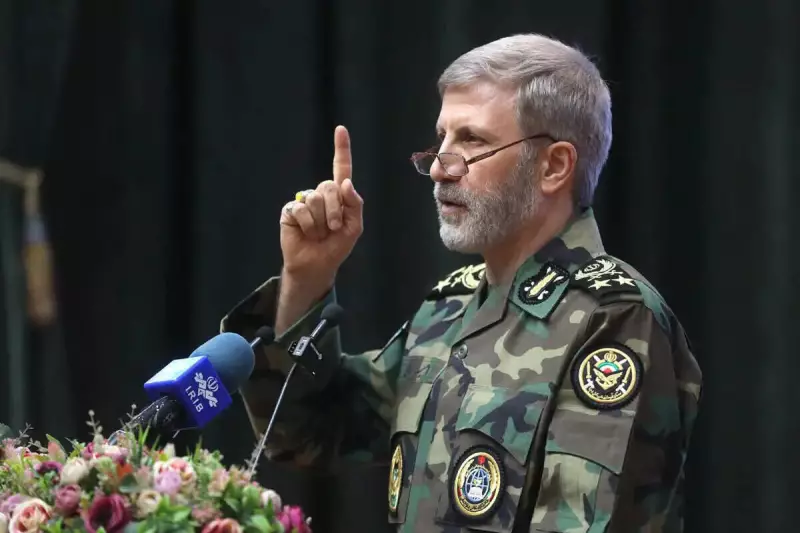
Iran's top military commander has issued a stark warning of potential preemptive action against perceived threats from the United States and Israel, as the nation grapples with widespread protests fueled by a severe economic crisis. The dual challenges highlight the mounting pressure on Tehran's leadership.
Army Chief's Stern Warning Amid Rising Tensions
Major General Amir Hatami, the commander-in-chief of Iran's regular army (Artesh), directly addressed the escalating war of words with the United States on Wednesday. Speaking to military academy students, Hatami stated that Iran views the intensifying rhetoric as a direct threat and will not let it continue unanswered.
"If the enemy commits an error, it will face a more decisive response, and we will cut off the hand of any aggressor," Hatami declared, according to the state-run IRNA news agency. He expressed confidence that the readiness of Iran's armed forces is now far greater than before the recent conflict.

This strong statement is seen as a direct response to recent comments from US President Donald Trump, who warned that America would intervene if Iran violently cracked down on peaceful protesters. The threat gained further significance after a US military operation captured Venezuelan President Nicolás Maduro, a key Iranian ally, over the weekend.
Hatami's appointment itself is significant. He is the first regular military officer in decades to hold the army chief position, a role long dominated by the powerful paramilitary Revolutionary Guard. He took command after Israel killed several top Iranian military commanders during a 12-day war in June.
Economic Despair Fuels Nationwide Protests
The military threats unfold against a backdrop of deep domestic unrest. Protests that began on December 28, triggered by the crashing value of the Iranian rial and soaring prices, have now entered their eleventh day. Demonstrations have spread to over 280 locations across 27 of Iran's 31 provinces.
According to the US-based Human Rights Activists News Agency, the death toll has reached 36, including 30 protesters, four children, and two members of Iran's security forces. The group, which relies on an activist network inside Iran, has been accurate in reporting past unrest.
"More than a week of protests in Iran reflects not only worsening economic conditions, but longstanding anger at government repression and regime policies that have led to Iran’s global isolation," analyzed the New York-based Soufan Center think tank.
Government Rolls Out New Subsidy Amid Currency Collapse
In a bid to quell public anger, the Iranian government initiated a new subsidy payment on Wednesday. Heads of households across the country began receiving 10 million Iranian rials (approximately $7) in their bank accounts to help offset rising costs for essentials like rice, meat, and pasta.
While this amount is more than double the previous subsidy of 4.5 million rials, its real value is severely eroded by hyperinflation and a collapsing currency. The Iranian rial now trades at over 1.4 million to the US dollar and continues to depreciate rapidly.
Shopkeepers warn that prices for basic items like cooking oil could triple. This is due to the end of a preferential, subsidized dollar-rial exchange rate for importers and the general economic pressure from international sanctions. Iranian media already report sharp price hikes for cooking oil, poultry, and cheese.
Iran's Vice President for Executive Affairs, Mohammad Jafar Ghaempanah, acknowledged the severity of the crisis, telling reporters that the country is in a "full-fledged economic war." He called for "economic surgery" to eliminate corrupt rentier policies within the nation.
As Iran's army talks of external threats and the government attempts economic band-aids, the protests on the streets show no signs of stopping, presenting the theocracy with one of its most serious combined challenges in recent years.






