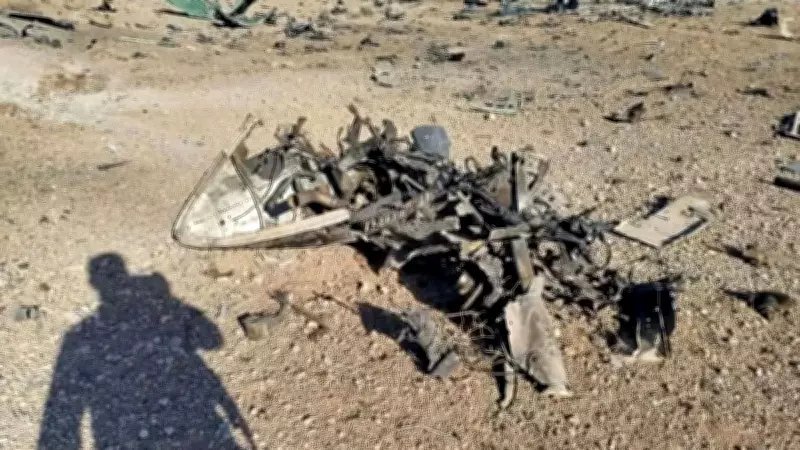
Iran's innovative use of jellyfish-like drones in a coordinated formation successfully downed a US F-15E Strike Eagle fighter jet, the rescued pilot revealed in a debriefing. The incident, which occurred over the Persian Gulf, marks a significant milestone in drone warfare, demonstrating the vulnerability of advanced manned aircraft to swarming unmanned aerial vehicles.
Details of the Encounter
The pilot, whose name has not been disclosed for security reasons, stated that the F-15E was on a routine patrol mission when it encountered a dense cluster of drones. These drones, described as having a jellyfish-like appearance with multiple tentacles, operated in a tightly coordinated swarm. The pilot reported that the drones emitted electromagnetic pulses that disrupted the jet's avionics, causing a critical system failure.
According to the pilot, the formation of drones moved in a fluid, unpredictable pattern, making it difficult for the F-15E's countermeasures to lock onto individual targets. The swarm approached from multiple directions, overwhelming the aircraft's defensive systems. The pilot ejected safely and was rescued by US Navy search-and-rescue teams within hours.

Technical and Tactical Implications
This incident underscores the growing threat of drone swarms in modern warfare. Military analysts have long warned that low-cost, expendable drones could neutralize high-value assets like fighter jets. The jellyfish drones, believed to be part of Iran's expanding unmanned aerial vehicle program, represent a leap in swarm technology. They are equipped with electronic warfare capabilities and can operate autonomously or under remote control.
“This is a game-changer,” said a defense expert from the Center for Strategic and International Studies. “The ability of a swarm to take down a fourth-generation fighter like the F-15E shows that even advanced air forces must rethink their tactics and countermeasures.”
The Pentagon has acknowledged the incident and stated that it is investigating the technology used. A spokesperson said, “We are aware of the downing of an F-15E in the Persian Gulf and are working to enhance our defenses against such threats.”
Broader Context and Regional Impact
The downing comes amid heightened tensions between the US and Iran. The US has maintained a military presence in the region, while Iran has continued to develop its drone capabilities. In recent years, Iran has showcased various drones, including the Shahed series, but the jellyfish design appears to be a new addition to its arsenal.
The incident has sparked debate among military strategists about the future of air combat. Some argue that manned aircraft may become obsolete in contested airspace dominated by swarms. Others believe that electronic warfare and directed-energy weapons could provide effective countermeasures.
The rescued pilot, now recovering from minor injuries, praised the ejection system and the swift rescue operation. “I never imagined a swarm of drones could bring down a jet like that,” he said. “But they did. We need to adapt quickly.”
As the US reviews its aerial combat strategies, the jellyfish drone incident serves as a stark reminder of the evolving nature of warfare, where innovation and asymmetry can level the playing field.