

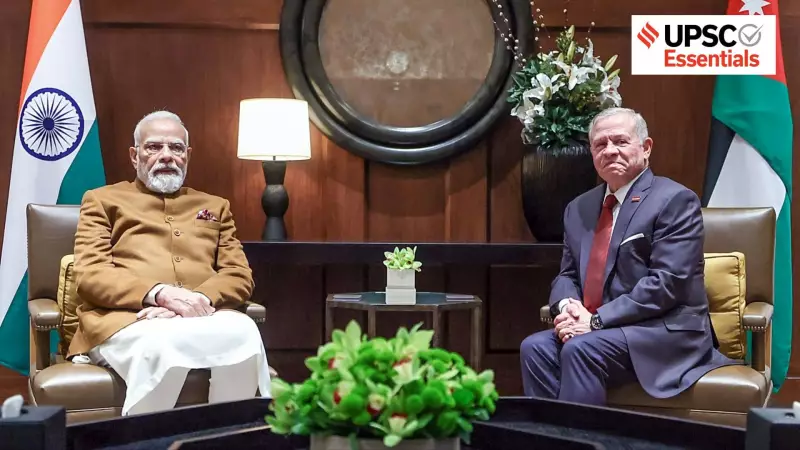
Prime Minister Narendra Modi's official visit to Jordan on December 15-16, 2025, marks a significant recalibration of India's diplomatic engagement with the Middle East. This trip, the first standalone prime ministerial visit to the Hashemite Kingdom since 1988, signals a deliberate move to deepen ties with a nation that holds considerable strategic, political, and economic value for New Delhi's interests in a volatile region.
Reinvigorating a Historic but Understated Partnership
The visit underscores a renewed dynamism in India's foreign policy under Prime Minister Modi and External Affairs Minister S. Jaishankar. Formal relations between India and Jordan were established in 1950, but high-level engagements have been sporadic. The last Indian Prime Minister to visit was Rajiv Gandhi in 1988. From the Jordanian side, King Abdullah II visited India in 2006 and again in February 2018.
This historical infrequency made President Pranab Mukherjee's 2015 trip to Amman a landmark, a momentum that Modi's 2025 visit has powerfully reinforced. The prolonged gap in vigorous engagement, especially post-Cold War, was puzzling given Jordan's outsized importance for a rising power like India.

The Pillars of Jordan's Strategic Significance for India
Jordan's value is multifaceted. Geopolitically, it sits at a crucial crossroads in the Levant, sharing borders with Saudi Arabia, Iraq, Syria, Israel, and the Palestinian territories, with access to the Gulf of Aqaba. This makes it a vital access point and a stable actor in a turbulent neighbourhood.
Its political positioning is equally critical. Jordan maintains relations with Israel while steadfastly supporting Palestinian statehood, navigating a complex diplomatic landscape with notable balance. Furthermore, the Kingdom's role as custodian of Jerusalem's Haram al-Sharif/Temple Mount sites grants it unique religious and cultural influence.
Economic Synergies and the IMEEC Corridor
Beyond strategy, strong economic drivers exist. Bilateral trade, currently at $2.6 billion, was a key discussion point, with both leaders setting an ambitious target to elevate it to $5 billion within five years.
Jordan presents opportunities for Indian businesses in infrastructure, IT, digital solutions, pharmaceuticals, and renewable energy. Its location in the gas-rich Eastern Mediterranean is attractive for Indian energy firms. Crucially, Jordan's geography is integral to the proposed India-Middle East-Europe Economic Corridor (IMEEC), a flagship initiative set to pass through the kingdom, linking Indian trade to Western Europe.
Outcomes of the 2025 Visit: Strengthening the Framework
During the visit, PM Modi held extensive talks with King Abdullah II. The leaders discussed cooperation on counter-terrorism, post-pandemic health challenges, and enhancing defence and security ties. A significant outcome was the signing of five Memoranda of Understanding (MoUs), covering:
- Technical cooperation in new and renewable energy.
- Water resources management and development.
- A twinning agreement between the heritage sites of Petra and Ellora.
- Renewal of the cultural exchange programme for 2025-2029.
- A Letter of Intent on sharing successful digital solutions for population-scale transformation.
PM Modi and King Abdullah also jointly addressed the India-Jordan Business Forum, urging the business community to leverage the growing partnership. The Prime Minister's itinerary included a tour of the ancient city of Petra, led by Crown Prince Hussein bin Abdullah, highlighting historical trade links with India, and an interaction with the Indian diaspora in Jordan.
Charting a Multi-Aligned Future Beyond the Gulf
Prime Minister Modi's Jordan visit is a clear indicator of India's evolving, multi-aligned approach to the Middle East. It moves beyond the traditional focus on the Persian Gulf, seeking a more comprehensive regional engagement. Jordan's stability and strategic location make it an ideal partner for this expanded vision.

This nuanced diplomacy, championed by the current Indian leadership, aims to secure India's energy, trade, and security interests while bolstering its role as a credible and engaged global power. The visit to Amman is not just a bilateral event; it is a strategic statement that India's Middle East policy is becoming more energetic, diversified, and strategically ambitious.





