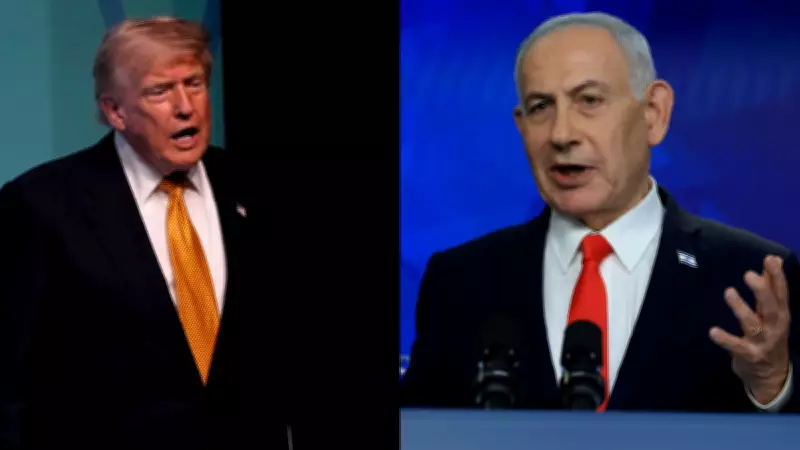
Former US President Donald Trump and Israeli Prime Minister Benjamin Netanyahu held a phone conversation to discuss American military movements in the Persian Gulf region, following recent US airstrikes on Iranian targets. The discussion centered on the implications of the strikes and the broader security landscape in the Middle East.
Key Topics of the Call
According to a statement from Netanyahu's office, the two leaders reviewed the latest developments concerning American forces in the Gulf. The conversation highlighted the importance of maintaining stability and deterrence against Iranian aggression. Netanyahu expressed support for the US actions, emphasizing the need for a coordinated approach to counter Iran's nuclear ambitions and its proxy networks in the region.
The call also touched on the potential for expanded security cooperation between Israel and the United States, particularly in intelligence sharing and joint military exercises. The leaders agreed to continue coordinating closely on regional threats.

Context of the US Strikes
The US airstrikes on Iran were conducted in response to attacks on American personnel and interests in the Middle East. The Pentagon reported that the strikes targeted facilities used by Iran's Islamic Revolutionary Guard Corps and affiliated groups. The operation was intended to degrade Iran's ability to launch future attacks and to signal US resolve.
In the aftermath, the US has increased its military presence in the Gulf, including the deployment of additional naval assets and fighter aircraft. These moves are part of a broader strategy to protect shipping lanes and deter Iranian provocations.
Regional Reactions
The strikes and subsequent US force posture have drawn mixed reactions from Gulf states. Saudi Arabia and the United Arab Emirates have privately welcomed the US actions, viewing them as a check on Iranian expansionism. However, they have also urged restraint to avoid a full-scale conflict that could destabilize the region.
Iran has condemned the strikes as a violation of its sovereignty and has vowed retaliation. The Iranian Foreign Ministry called for an emergency meeting of the United Nations Security Council to address what it termed US aggression.
Implications for Israel
For Israel, the US strikes represent a significant shift in American policy toward Iran, which has been a top priority for Netanyahu. The prime minister has long advocated for a tougher US stance on Iran's nuclear program and its regional proxies. The call with Trump is seen as an effort to align Israeli and American strategies in the wake of the military action.
Analysts suggest that the conversation may also have covered the status of negotiations over Iran's nuclear deal, known as the JCPOA. While the US has not directly linked the strikes to the nuclear talks, the timing suggests a hardening of positions.
Future Outlook
Both leaders emphasized the need for continued vigilance and cooperation. The White House stated that the US remains committed to the security of its allies in the region, including Israel. The call ended with an agreement to remain in close contact as the situation evolves.
The developments underscore the volatile security environment in the Gulf and the central role of US-Israeli coordination in shaping regional dynamics.