

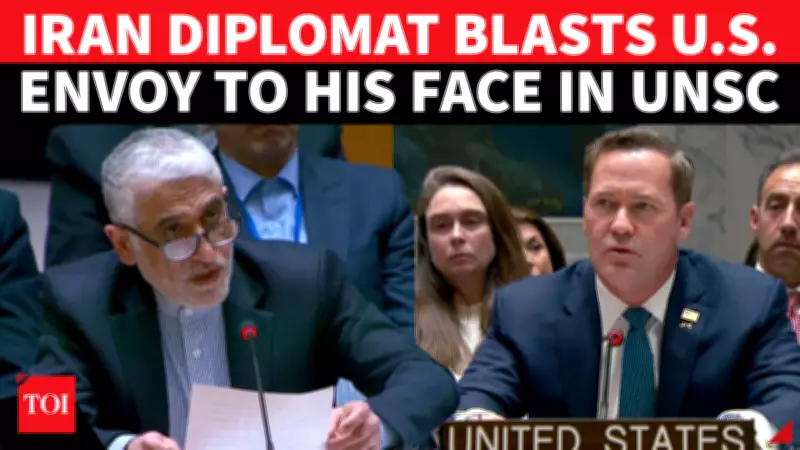
UN Security Council Erupts in Heated Exchange Over Iran Strikes
A dramatic and highly charged confrontation unfolded at the United Nations Security Council as diplomatic tensions reached a boiling point. Iranian officials launched a fierce verbal assault against their American and Israeli counterparts, accusing them of spreading falsehoods regarding recent military actions.
Iran's Diplomat Delivers Blistering Rebuke
The Iranian envoy to the UN did not mince words, directly confronting the representatives from the United States and Israel. "Your lies and fabrications are exposed," the diplomat declared, setting the tone for a session marked by sharp accusations and counter-accusations. The Iranian official condemned recent strikes on Iranian territory as "unjustified aggression" and labeled them a clear war crime.
In a detailed condemnation, the envoy alleged that these military operations resulted in significant civilian casualties, including the tragic deaths of children. The Iranian presentation framed the attacks as a blatant violation of international law and sovereignty, demanding immediate accountability from the nations involved.

U.S. Defense and Justification of Military Action
In a robust defense of its policy, the United States ambassador to the UN articulated the rationale behind President Donald Trump's decision to authorize strikes. The American diplomat argued that decisive military action was not only necessary but imperative, asserting that diplomatic channels alone had proven insufficient to deter what was described as "credible threats to regional allies."
Washington categorically rejected Iran's claims regarding civilian harm and the nature of the operations. The U.S. delegation framed the military response as defensive and essential for maintaining regional security and stability. The ambassador emphasized that the action was a measured response to specific threats, aimed at protecting American interests and those of allied nations in the strategically vital region.
Escalating Rhetoric and Regional Implications
The Security Council clash underscores the severe deterioration in relations and the potential for further escalation. The exchange of accusations highlights the deep-seated mistrust and conflicting narratives that dominate the geopolitical landscape involving Iran, the United States, and Israel.
Key points of contention from the session include:
- The Iranian accusation of war crimes and civilian casualties.
- The U.S. justification of strikes as a necessary defensive measure.
- The fundamental disagreement over the legitimacy and proportionality of the military actions.
- The broader implications for regional diplomacy and security architecture.
This public diplomatic fracas at the highest level of international governance signals a challenging path ahead for conflict resolution and dialogue. The hardening of positions and the exchange of grave allegations suggest that de-escalation will require significant diplomatic effort and third-party mediation to bridge the substantial gap in perceptions and stated objectives.

