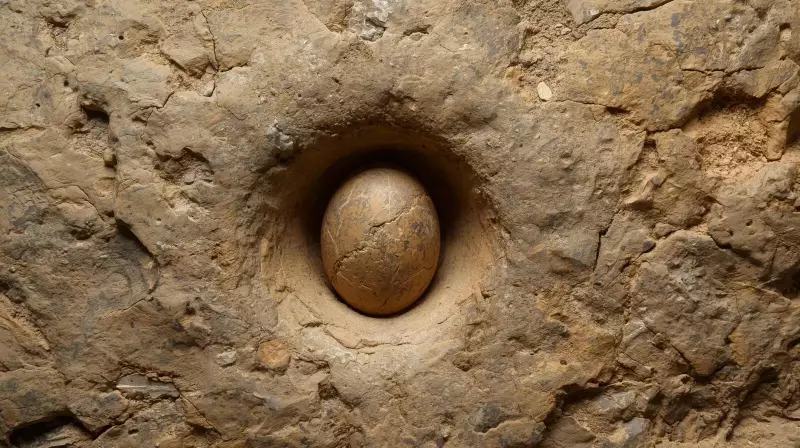
At first glance, it seemed like just another rounded fossil, one among many unearthed from a dry, ancient nesting ground in the heart of India. But when researchers took a closer look, they knew they had stumbled upon something extraordinary. This unassuming discovery, a dinosaur egg hiding a secret within, is now challenging long-held assumptions about how these prehistoric giants reproduced.
A Startling Discovery in Madhya Pradesh
The remarkable fossil was recovered from the Lameta Formation near Padlya village in Madhya Pradesh, a region already famed for its sauropod nesting sites. Dating back to the Late Cretaceous period, approximately 68 million years ago, the egg belonged to a titanosaur, one of the colossal plant-eating dinosaurs that once roamed the land.
While its size—roughly 16.6 centimetres long and 14.7 centimetres wide—was typical for a titanosaur, its internal structure was anything but. Scientists observed two distinct eggshell layers, one nestled perfectly inside the other. Curved shell fragments were trapped between these layers, and a crescent-shaped break on the outer shell confirmed this was no ordinary crack caused by pressure over time.

Ovum in Ovo: A Bird-Like Anomaly in a Dinosaur
The condition identified in this fossil is known as ovum in ovo (egg within an egg), a rare phenomenon observed in modern birds but never before confirmed in dinosaurs. It occurs when a nearly formed egg reverses direction in the oviduct and gets encased in a second shell layer.
This finding, led by palaeontologist Guntupalli Prasad from the University of Delhi and published in the journal Nature, disrupts the conventional view that dinosaur reproductive systems were simple and closely mirrored those of reptiles. Instead, it suggests titanosaurs possessed a more complex, segmented oviduct anatomy, akin to birds and crocodiles, rather than lizards or turtles.
What This Means for Dinosaur-Bird Evolution
The link between birds and dinosaurs is well-established through evidence like feathers and bone structures. This egg-in-egg pathology adds a crucial new layer to that connection. It implies that some reproductive mechanisms, previously thought to be unique to birds, might have existed in their dinosaur ancestors.
This does not mean titanosaurs laid eggs exactly like chickens. However, it nudges them closer to birds in a specific biological detail, indicating that evolution of reproductive traits was piecemeal. The discovery places titanosaurs in a fascinating middle ground, similar to crocodilians, which have segmented reproductive tracts but lay eggs in a more reptilian fashion.
A Quiet Revolution in Palaeontology
This single, double-shelled egg does not rewrite textbooks overnight, but it steadily erodes old assumptions. It supports the growing understanding that dinosaur biology was complex, varied, and shared deeper traits with modern animals than once believed.
Fossilised eggs with abnormalities—multiple shells, uneven thickness, or distorted shapes—are biological mistakes frozen in time. They serve as vital clues to stress, illness, or anatomical limits. In this case, the "mistake" of an egg inside an egg points not to failure, but to an advanced and intricate reproductive system.
The story concludes with a quiet yet profound artifact: a 68-million-year-old egg, buried in Indian soil, cradling another within. It is a powerful reminder that ancient life was as messy, inconsistent, and occasionally strange as the natural world we see today.