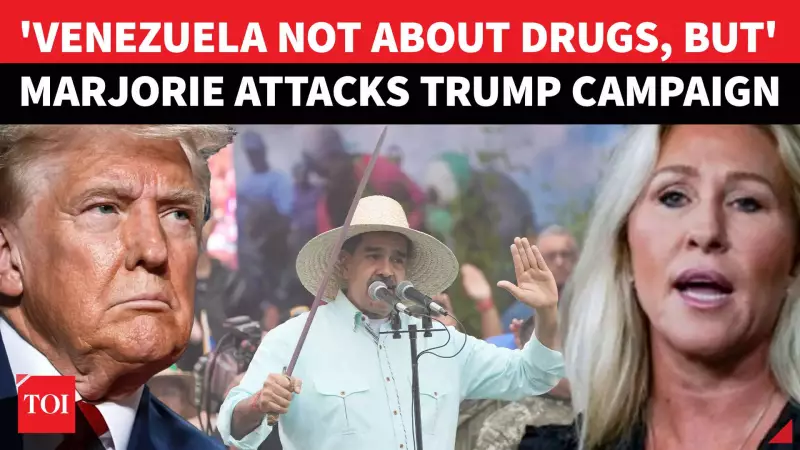
In a significant political intervention, Republican Congresswoman Marjorie Taylor Greene, a former ally of Donald Trump, has launched a sharp critique against the United States government's escalating actions targeting Venezuela. The controversy erupted on December 23, 2025, when Greene took to social media platform X to voice her dissent.
Questioning the Motives Behind US Intervention
Greene framed her argument around the 2024 election mandate, reminding officials that American voters had expressed clear opposition to foreign intervention and regime change operations. She cast doubt on the official justifications provided by Washington for its hardened stance against Caracas, which typically cite concerns over drug trafficking and violations involving sanctioned oil tankers.
The congresswoman asserted that, based on her conversations, most Americans are not convinced that these are the genuine reasons driving the policy. She suggested a deeper, more complex geopolitical motive is at play, shifting the narrative away from social and legal issues.

The Israeli Connection and Ideological Divide
Central to Greene's argument was her focus on Venezuelan opposition figure Maria Corina Machado. Greene highlighted Machado's established ties with Israel, presenting it as a key factor often overlooked in mainstream discourse.
In a striking comparison, she contrasted the political ideologies of Machado and sitting President Nicolas Maduro. Greene pointed out that while Machado holds "left-leaning" positions on culturally divisive topics like abortion and LGBTQ rights, President Maduro maintains a more conservative stance on these domestic social issues.
However, Greene placed greater emphasis on Maduro's firm opposition to Zionism, implying that this ideological conflict, intertwined with Machado's Israeli connections, is a critical subtext in the current US-Venezuela confrontation. This framing introduces a new dimension to the ongoing "oil war" and geopolitical standoff.
Broader Geopolitical Repercussions
Greene's public criticism arrives at a tense moment, as global powers choose sides. Russian President Vladimir Putin and Chinese leader Xi Jinping have publicly rallied behind Venezuela, pledging support against the US campaign. This alignment has transformed the situation into a proxy arena for major power competition.
The congresswoman's remarks break from the traditional stance of her party, directly challenging the approach of the Trump administration, which has reportedly presented President Maduro with stark ultimatums. Her commentary underscores a growing debate within American politics about the scope and purpose of foreign engagements, particularly when they involve complex energy economics and entrenched ideological battles.
By connecting the dots between Venezuelan opposition politics, Israeli foreign relations, and the principle of Zionism, Marjorie Taylor Greene has ignited a fresh controversy that questions the foundational motives behind US foreign policy in Latin America. Her statements promise to fuel further discussion on America's role in regional regime dynamics and the often-hidden factors influencing international conflicts.