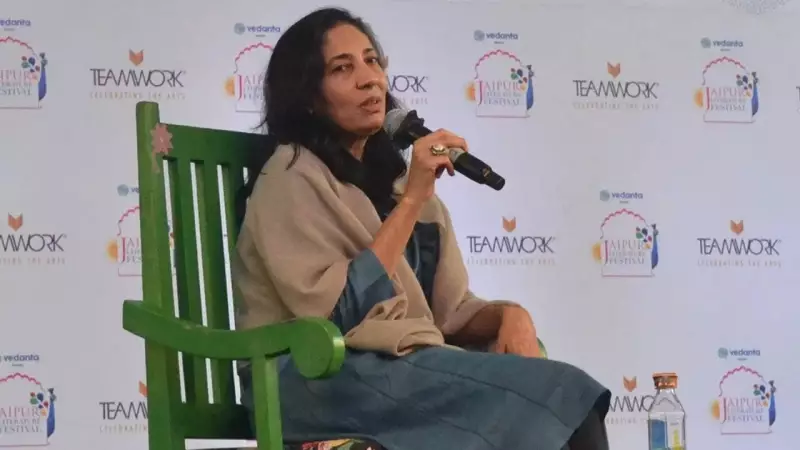
Indian American author Kiran Desai has described the current atmosphere surrounding immigration in the United States as potentially serving as a profound "wake-up call" and a "real lesson in empathy" for the Indian community, both domestically and within the diaspora. Speaking exclusively to New India Abroad during the Kerala Literature Festival in Kozhikode on January 24, Desai highlighted how hardening rhetoric and pervasive fear are reshaping immigrant experiences.
A Personal and Political Reflection
Desai, whose novel 'The Loneliness of Sonia and Sunny' was recently shortlisted for the Booker Prize, expressed deep concern over the "very disconcerting" present moment in the US. She noted that many in the Indian diaspora had previously focused on preserving secular democracy in America while paying less attention to similar issues in India. "So now I'm wondering if this is a bit of a wake up call, which would be a good thing," she remarked. "I mean, this may be a real lesson in empathy, I think."
Her observations stem from both personal experience and political awareness, shaped by years living in Jackson Heights, Queens—one of New York City's most immigrant-dense neighborhoods. From her apartment window, Desai witnessed the tangible impact of national debates. "I could see a lot of that vibrancy subtracted and a lot of fear," she said, emphasizing that the entry of fear into daily life is particularly alarming. "That is what disconcerts me the most is the entry of fear into the landscape because I know that when it comes to democracies that, you know, it's sort of the beginning of the end when people are too scared to speak and are staying home and there's an atmosphere of fear."

Global Perspectives on Migration
Desai cautioned against viewing the US situation in isolation, pointing to parallel trends in India and worldwide. "There's been a lot of anti-migrant, immigrant rhetoric in India too and a lot of fear here as well," she observed. "So one has to see it also in global perspective. It's happening everywhere. It leaves migrants and minorities feeling very vulnerable and certainly the Indian diaspora too."
This sense of instability, she explained, fundamentally alters how immigrants perceive their adopted and home countries. "Then the ground sort of shifts under your feet, doesn't it?" Desai questioned. "Because you think you've immigrated to a country and then all of a sudden you lose that little sense of belonging that you were beginning to develop."
Migration and Artistic Expression
Drawing connections between migration and the creative process, Desai noted overlapping vocabularies. "I think the vocabularies overlap, you know, migration, translation, many perspectives, a sense of moral ambiguity, fluidity," she said. "And migration and the artistic language also, you know, it's very compatible."
She described the writer's life as one of constant movement between worlds, making immigration and artistry naturally aligned. "As an artist, you're also constantly occupying different worlds," Desai explained. "So in a way, being an immigrant, it's a wonderful thing to be both an immigrant and a writer." She further linked loneliness and solitude to both artistic pursuits and immigrant experiences, calling them "absolutely an essential part of the vocabulary of immigration and migration."
Challenges for Diaspora Writers
Addressing expectations placed on diaspora authors, Desai acknowledged persistent pressure to simplify complex narratives. "People want that countries want a simple narrative," she said. "They want one book on the shelf." However, she championed complexity and syncretism, referencing a line from her Booker-shortlisted novel: "in India, stories grow on trees."
Desai also expressed concern over diminishing literary openness in the US, noting that "books are being taken off the bookshelves, you know, as we know," indicating a broader cultural shift affecting immigrant voices.

Hope in Younger Voices
Despite these challenges, Desai welcomed the emergence of younger political figures like Zohran Mamdani, who actively defend immigrants and minorities. "Well, I'm so glad he's young and has the confidence of youth and will speak out against Trump's policies, will speak up for immigrants, minorities," she said. "I mean, you know, there seems to be no respect for the immense amount of work immigrants do."
Reflecting on her neighborhood, she highlighted the visible reality of immigrant labor. "These are people who work all day and all night," Desai stated. "So I'm so proud and happy that we have somebody from our part of the world—in fact, half from our part of the world, half of it—who is speaking up for us."
Through her insights, Kiran Desai underscores a critical moment for the Indian diaspora, urging empathy and awareness as global anti-immigrant sentiments challenge notions of belonging and identity.