

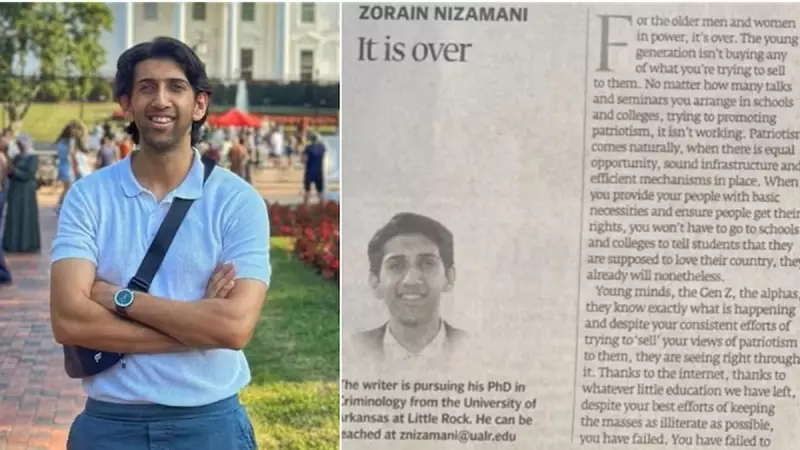
A thought-provoking opinion piece written by a Pakistani doctoral student has taken the internet by storm, igniting a fierce debate about the potential for a youth-led political revolution in Pakistan. The article, authored by Zorain Nizamani, a PhD candidate at the University of California, Berkeley, speculates about the possibility of a "Gen Z uprising" in Pakistan by the year 2026.
The Viral Thesis: Can Pakistan's Youth Spark Change?
Zorain Nizamani's op-ed, originally published in a Pakistani newspaper, presents a compelling analysis of the country's current socio-political climate through the lens of its massive young population. Nizamani, who is pursuing his doctorate in South Asian Studies, argues that the convergence of economic frustration, political disillusionment, and digital connectivity could create a perfect storm for significant change.
He points to Pakistan's demographic reality, where a large percentage of the population is under 30, and suggests that this generation, Gen Z, is markedly different from its predecessors. Armed with smartphones and global awareness, they are increasingly vocal about issues like unemployment, climate change, and institutional accountability. Nizamani's central claim is that if the existing political structures fail to address these core grievances, a large-scale, youth-driven movement could become inevitable.

Who is Zorain Nizamani?
The author behind the viral text is Zorain Nizamani, a scholar whose academic work focuses on political movements and digital activism in South Asia. His background as a Pakistani student at a prestigious international university like UC Berkeley lends a unique dual perspective to his writing. He observes Pakistan's internal dynamics while also understanding global patterns of youth mobilization, such as those seen in other regions.
His article is not a call to arms but rather an analytical forecast. It meticulously outlines the factors that could fuel unrest, including the worsening economic crisis, perceived corruption, and the growing gap between the public and the political elite. The piece resonated deeply because it gave a name and a timeframe—2026—to a simmering sentiment many young Pakistanis express online daily.
Online Firestorm and Divided Reactions
Since going viral, Nizamani's op-ed has triggered a massive wave of reactions across social media platforms and news outlets. The debate is sharply polarized.
On one side, many young Pakistanis and analysts have hailed the article for articulating their frustrations and hopes. They see it as a validation of their desire for systemic change and a more equitable future. Comments and shares often carry tags like #GenZ and references to the predicted year 2026.
On the other side, critics have accused Nizamani of being overly simplistic or of inciting unnecessary unrest. Some conservative voices argue that his analysis underestimates the complexity of Pakistan's political landscape and the role of traditional institutions. Others question the feasibility of such an uprising, given the country's security apparatus.
The discussion has transcended Pakistan's borders, attracting attention from international observers studying youth politics and digital activism. The core question remains: Is this a prophetic warning or merely speculative commentary?
Implications and the Road to 2026
Regardless of where one stands, the viral nature of Zorain Nizamani's op-ed underscores a critical truth: the voice of Pakistan's youth is growing louder and more impossible to ignore. The article has successfully placed the potential of Gen Z as a political force squarely into the national and international conversation.
The piece serves as a mirror to the establishment, highlighting the urgent need for meaningful engagement with the country's younger citizens. It suggests that the path to stability may lie in addressing the legitimate concerns of this demographic—creating jobs, ensuring justice, and providing a platform for participatory governance.

Whether the year 2026 will witness the uprising Nizamani hypothesizes is unknown. However, the explosive reaction to his words proves that the tinder for such a movement—widespread discontent among the youth—is very real. The coming years will be a test of whether Pakistan's systems can reform quickly enough to channel this energy constructively or face the consequences of a generation that has lost patience.





