

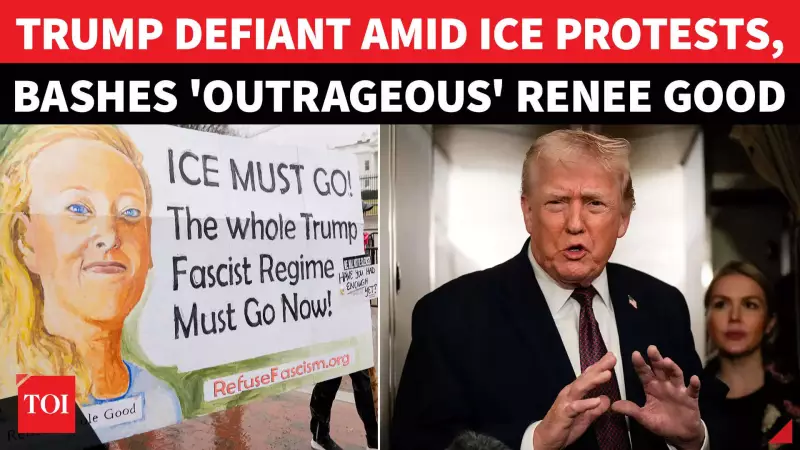
In a fiery defense of federal law enforcement, U.S. President Donald Trump has thrown his full support behind an Immigration and Customs Enforcement (ICE) officer involved in a fatal shooting in Minnesota. Speaking to reporters aboard Air Force One on January 12, 2026, the President demanded "absolute immunity" for the agent while placing blame squarely on the deceased, Renee Good, and her associates.
Trump's Allegations Against the Victim
President Trump characterized Renee Good and her group as "highly disrespectful" towards law enforcement officials. He accused them of engaging in a campaign of harassment, agitation, and intimidation against federal officers over a period of several days leading up to the incident. According to Trump, such actions create an environment of extreme threat for personnel carrying out their duties.
When pressed by journalists on whether the use of deadly force was necessary in this specific case, the President avoided detailing the officer's actions. Instead, he reiterated his unwavering support for law enforcement agencies. He suggested the existence of organised agitation targeting ICE operations and vowed to investigate potential sources funding these protests.

Linking the Incident to Border Security Agenda
Trump strategically connected the Minnesota event to the broader issue of border security, a cornerstone of his political platform. He argued that ICE, Border Patrol, and police officers face constant danger and pressure while executing enforcement actions related to the border. The President claimed this issue was central to his landslide election victory.
He further blamed the previous administration for policies he said allowed millions of undocumented migrants into the country. Trump repeatedly tried to draw a connection between robust border enforcement and improved crime statistics across the United States, framing the incident as part of a larger national security struggle.
Broader Context and Reactions
The shooting of Renee Good has ignited significant public outcry, with reports of large-scale protests in cities like Minneapolis, Philadelphia, and Boston. The President's comments, made en route on Air Force One, are likely to further polarize public opinion on immigration enforcement and police accountability.
Trump's defense of "absolute immunity" for federal agents in such scenarios marks a significant hardening of his administration's stance. It signals a clear priority on protecting officers from legal repercussions amid what he describes as a hostile environment fueled by activist groups. The full implications of this position for future enforcement actions and judicial proceedings remain to be seen.






