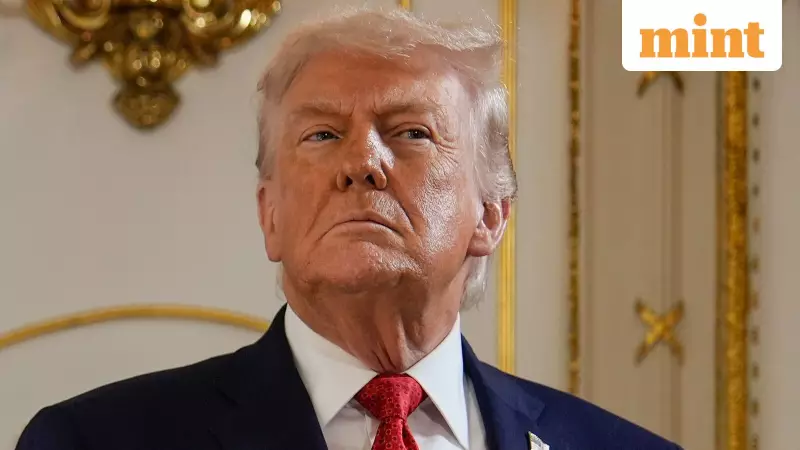
Former US President Donald Trump has strongly defended ambitious plans to construct a new ballroom at the White House, describing the project as a magnificent private gift to the nation while vehemently criticizing legal efforts to stop it.
A Private-Funded "Great Gift" to America
In a detailed post on his Truth Social platform, Trump characterized the proposed ballroom as a "great, big, beautiful gift" to the United States. He emphasized that the entire project, estimated to cost between $300 million and $400 million, would be financed exclusively with private funds without any taxpayer money.
"This is a GIFT (ZERO taxpayer funding!) to the United States of America," Trump wrote, clarifying that the construction is being supported by "Great American Patriots' money." His statement comes in response to a lawsuit filed by preservationists seeking to halt the ambitious construction project.

Addressing Long-Standing White House Needs
Trump argued that the new ballroom would fulfill a critical, long-standing requirement for a permanent and secure venue capable of hosting large state events. He noted that previous administrations over 150 years had sought such a dedicated space but had to rely on temporary structures instead.
"For over 150 years, previous Presidents and Administrations" pursued this type of permanent facility, Trump explained. He contended that the White House should no longer be "forced to use a cheap and unsafe 'tent'" for important state dinners, high-level meetings, international conferences, and future presidential inaugurations.
The former president highlighted significant safety, security, and capacity concerns, particularly given the weather vulnerabilities of the White House lawn where temporary structures have traditionally been erected for major events.
Military and Security Collaboration
Trump revealed that the project has been developed in close coordination with key national security agencies from its inception. "Working closely with, right from the beginning, the United States Military and Secret Service," he stated, claiming the project has received their complete "design, consent, and approval."
He further disclosed that construction materials including structural steel, bulletproof windows, anti-drone roofing, marble, stone, and precast concrete have already been ordered, making any project stoppage impractical at this stage.
"There is no practical or reasonable way to go back. IT IS TOO LATE!" Trump asserted in his social media post, suggesting the construction process has progressed beyond the point of reversal.
Sharp Criticism of Legal Challenge
Trump launched a fierce attack against the National Trust for Historic Preservation, which has filed the lawsuit to block the project. He referred to the organization as the "Radical Left National (No!) Trust for Historic Preservation" and questioned the timing of their legal action.
"Why didn't these obstructionists and troublemakers bring their baseless lawsuit much earlier?" he asked, noting that Congress had never attempted to stop the project and that "everyone knew what was taking place at the White House."
Trump further argued that the East Wing of the White House has undergone substantial modifications over decades and "bore no resemblance or relationship to the original building," suggesting historical preservation arguments lack merit in this context.
Presidential Authority Over White House Modifications
The former president asserted that presidents possess broad authority to modify the White House, citing its unique status among federal properties. "It's a place that a President has never needed permission to change or enhance," he wrote, "no matter how big (and important!) that enhancement may be."
Trump warned that halting construction at this stage would prove "devastating to the White House, our Country, and all concerned." He also claimed the lawsuit had inadvertently exposed what he described as a previously "Top Secret" security-related aspect of the project, though he did not provide specific details about this revelation.

The controversy emerges amid broader political discussions about presidential authority, historical preservation, and the appropriate use of private funding for federal property enhancements.