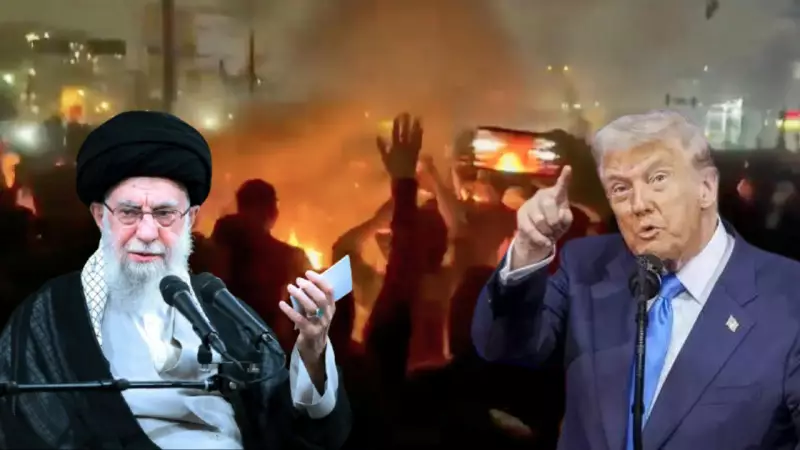
In a significant escalation of rhetoric, United States President Donald Trump declared on Sunday that Washington is actively considering military retaliation against Iran amidst deadly nationwide protests. Trump warned that any Iranian strike on American bases would be met with a response of unprecedented severity.
Trump's Stark Warning and Diplomatic Claims
Speaking to journalists aboard Air Force One, President Trump stated that his administration is closely watching the unrest in Iran and has been briefed on various intervention options. He asserted that Iran's leadership is nearing a "red line" concerning their treatment of protesters. When questioned about the potential US reaction to an attack on its assets, Trump was unequivocal: "we will hit them at levels that they’ve never been hit before."
In a notable claim, Trump suggested that Iranian officials, feeling pressure, have reached out to seek negotiations with the United States. "We may meet with them; a meeting is being set up, but we may have to act because of what is happening before the meeting," he said, without providing further details. He dismissed a question about Iran taking his threats seriously by referencing past actions like the elimination of Qasem Soleimani and Abu Bakr al-Baghdadi.

Mounting Human Toll and International Reactions
The context for these threats is a violent crackdown on protests within Iran. According to activists, at least 544 people have been killed since the demonstrations began, a number expected to rise. The US-based Human Rights Activists News Agency reported that 496 of the deceased were protesters, while 48 were security force members. More than 10,600 individuals have been detained over the past two weeks.
The United Nations' Independent International Fact-Finding Mission issued an urgent appeal on Sunday, calling on Iranian authorities to immediately restore internet and mobile communications and halt the violent suppression. Their report cited "credible information" that Iran's Supreme National Security Council ordered security forces to carry out a "decisive" and "unrestrained" crackdown.
Hospitals across Iran are reportedly under massive strain, with medical workers describing overwhelmed emergency rooms, overcrowded corridors, and morgues filled to capacity. Emergency services in several provinces, including Tehran, have spoken of "bodies piled on top of one another."
Regional Dynamics and Digital Warfare
Iranian President Masoud Pezeshkian has accused the United States and Israel of attempting to destabilise Iran by fomenting the unrest. While pledging to hear public grievances, he warned citizens against violent protesters, urging them to stay away from "rioters and terrorists."
Meanwhile, an Israeli official confirmed that Prime Minister Benjamin Netanyahu held overnight talks with US Secretary of State Marco Rubio to monitor the escalating tensions between Washington and Tehran.
On the digital front, President Trump revealed he plans to speak with billionaire Elon Musk about restoring internet access in Iran, where a four-day blackout has been imposed. He praised Musk's SpaceX-run Starlink satellite internet service as a potential solution. In a symbolic retort, Iran's Supreme Leader Ayatollah Ali Khamenei shared a cartoon on social media platform X portraying Trump as a crumbling sarcophagus, likening him to a pharaoh destined to fall.
The situation remains fluid, with the US weighing "very strong options" and the international community calling for restraint as the human cost continues to mount.