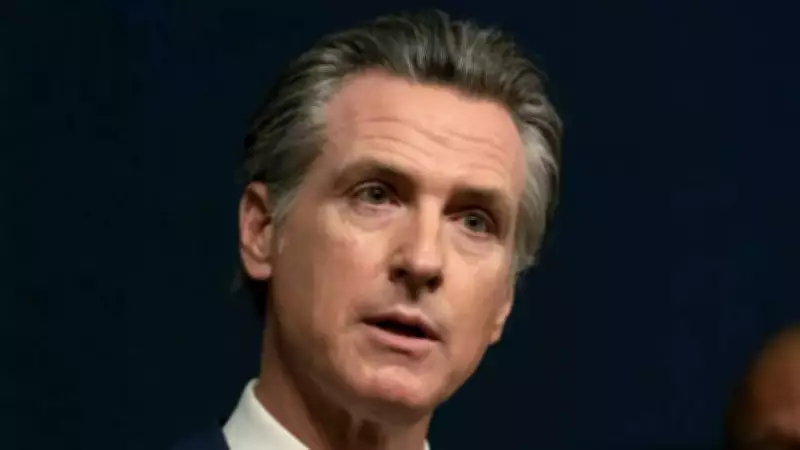
In a remarkable late-night social media surge, US President Donald Trump unleashed a torrent of 56 posts on his Truth Social platform within a single hour, targeting California and its Governor Gavin Newsom with multiple controversial claims. This digital blitz represents one of the most intense periods of presidential social media activity in recent memory, highlighting the ongoing political tensions between federal and state leadership.
The Content of Trump's Social Media Onslaught
Among the most prominent assertions in Trump's posts was a claim that retail giant Walmart would shut down 85 percent of its California stores. The President attributed this purported closure to the state's minimum wage policy, specifically mentioning a USD 22 figure that has circulated on social media platforms. However, this claim lacks substantiation from official data or corporate announcements.
AI-Generated Allegations Against Governor Newsom
Another particularly striking post featured an artificial intelligence-generated video that made serious allegations against Governor Gavin Newsom. The video, created using AI technology, falsely depicted Newsom as being involved in a drug-money laundering scheme with a Mexican cartel. This fabricated content portrayed the governor's office as a center of organized criminal activity, despite no evidence supporting such claims.

Trump's social media barrage also included posts targeting former President Barack Obama alongside continued criticism of Governor Newsom. Additionally, the President promoted newly surfaced footage that appears to show Minneapolis shooting victim Alex Pretti in a confrontation with federal agents several days before his fatal shooting.
Governor Newsom's Office Responds Forcefully
Governor Gavin Newsom's press office responded directly to Trump's claims through their official X account, issuing a clear and pointed rebuttal. The statement read: "Just to clarify: Walmart's 303 stores in California are open. The AI robot is lying. Governor Newsom is not Pablo Escobar."
The response continued with evident frustration: "We cannot believe we have to say any of this out loud... And we truly cannot believe this man has the nuclear codes. Deep breaths, everyone. Three more years." This exchange marks another chapter in the escalating public feud between Trump and Newsom, who have repeatedly clashed on numerous policy issues including state economic management, immigration policies, and the boundaries of federal authority.
Fact-Checking the Walmart Claims
Contrary to the assertions made in Trump's social media posts, Walmart has not announced any plans to close its California locations. As of current reporting, all 303 Walmart stores in California remain fully operational and open to customers. Retail analysts and industry observers note that there is no credible evidence linking potential store closures to minimum wage laws.
Major retail corporations like Walmart routinely adapt their operational strategies, including compensation structures and scheduling practices, to comply with local labor regulations without resorting to mass shutdowns. Independent verification and examination of the company's operational footprint in California confirm that claims about widespread store closures are completely unfounded.
The Broader Political Context
This social media exchange represents the latest development in an increasingly contentious relationship between President Trump and Governor Newsom. The two political figures have engaged in public disagreements across multiple policy domains, with California often serving as a focal point for debates about state versus federal authority, economic management approaches, and social policies.
The use of AI-generated content in political discourse raises significant concerns about misinformation and the potential for technology to create convincing but false narratives. As social media platforms continue to evolve as battlegrounds for political messaging, the verification of claims and responsible information sharing becomes increasingly crucial for maintaining public trust and informed democratic discourse.